 |
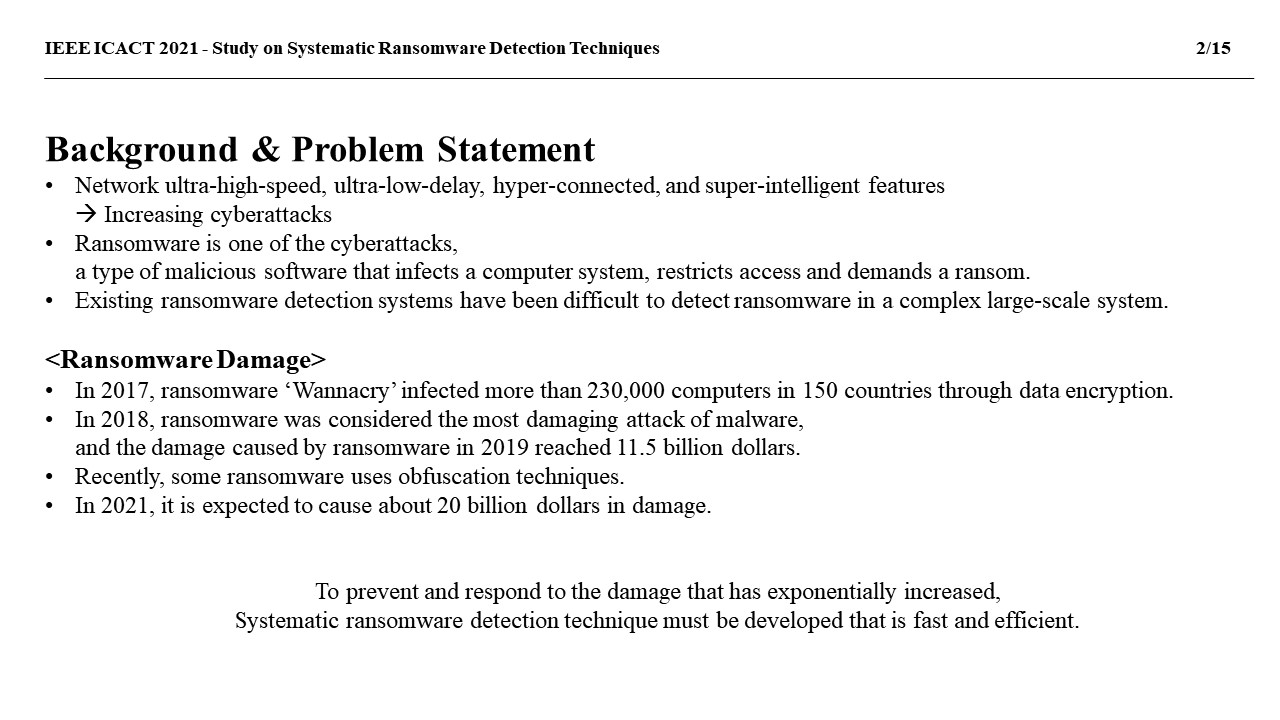
The number of cyberattacks is on the rise as it changes to a high-speed network, ultra-low latency, ultra-connected and ultra-intelligent society. One of the most common cyberattacks is ransomware, which is a type of malicious software that infects a computer system, restricts access and demands a ransom. However, existing ransomware detection systems have been difficult to detect ransomware in a complex large-scale system.
A prime example of a ransomware attack is Wannacry in 2017. This attack infected 230,000 computers in 150 countries. Also, ransomware was considered the most damaging attack among malware in 2018, and ransomware damage in 2019 amounted to $11.3 billion. Recently, some ransomware uses obfuscation techniques. In 2021, it is expected to cause about 20 billion dollars in damage.
So, to prevent and respond to the damage that has exponentially increased, systematic ransomware detection technique must be developed that is fast and efficient.
|
 IEEE/ICACT20210191 Slide.02
[Big Slide]