 |
Due to the rapid growth of data traffic and number of connected devices within a network, 5G communication networks and beyond must support fulfilling high connectivity requirements.
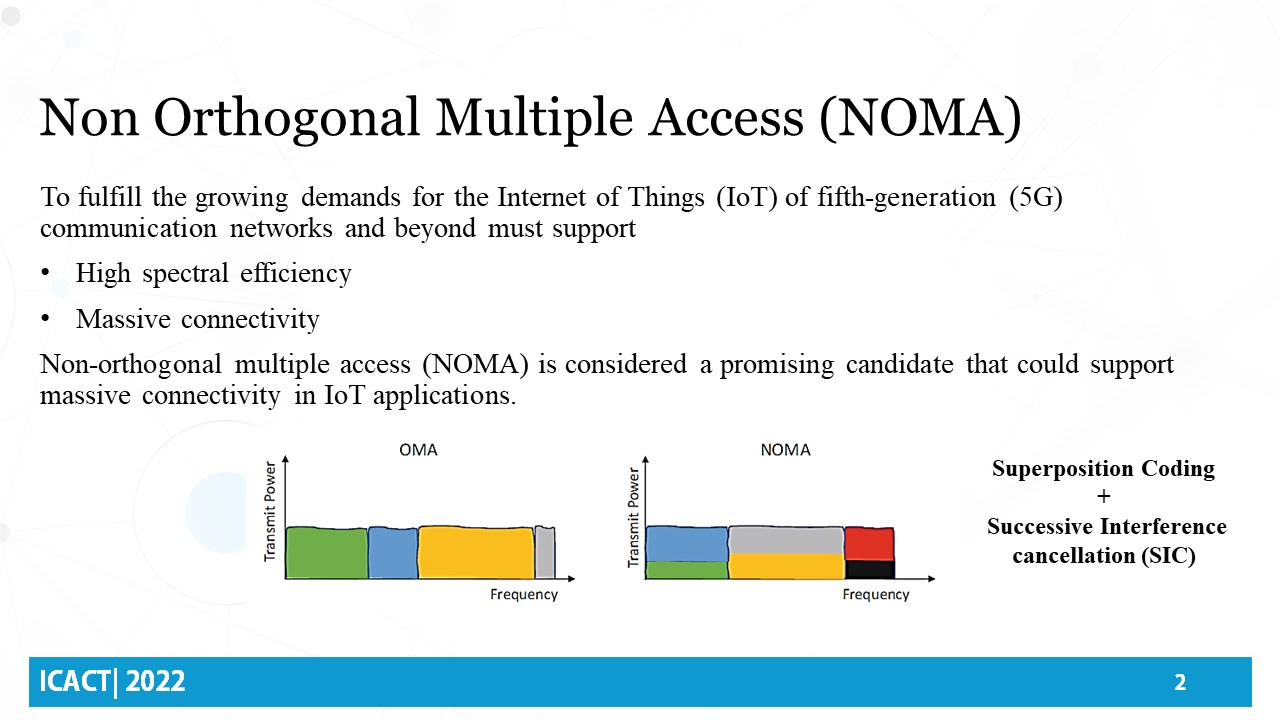
Non-orthogonal multiple access (NOMA) is considered a promising solution due to its potential to support massive connectivity in IoT applications.
In contrast to orthogonal multiple access (OMA), In NOMA, multiple user, with distinct channel gains, can share the same frequency band. This could be accomplished using superposition coding at the transmitter with different power coefficients assigned to different data symbols. At the receiver, successive interference cancellation (SIC) is used to extract the desired data symbol by eliminating unwanted information of other users according to the allocated power.
|
 IEEE/ICACT20220371 Slide.02
[Big Slide]
[YouTube]
IEEE/ICACT20220371 Slide.02
[Big Slide]
[YouTube]