 |
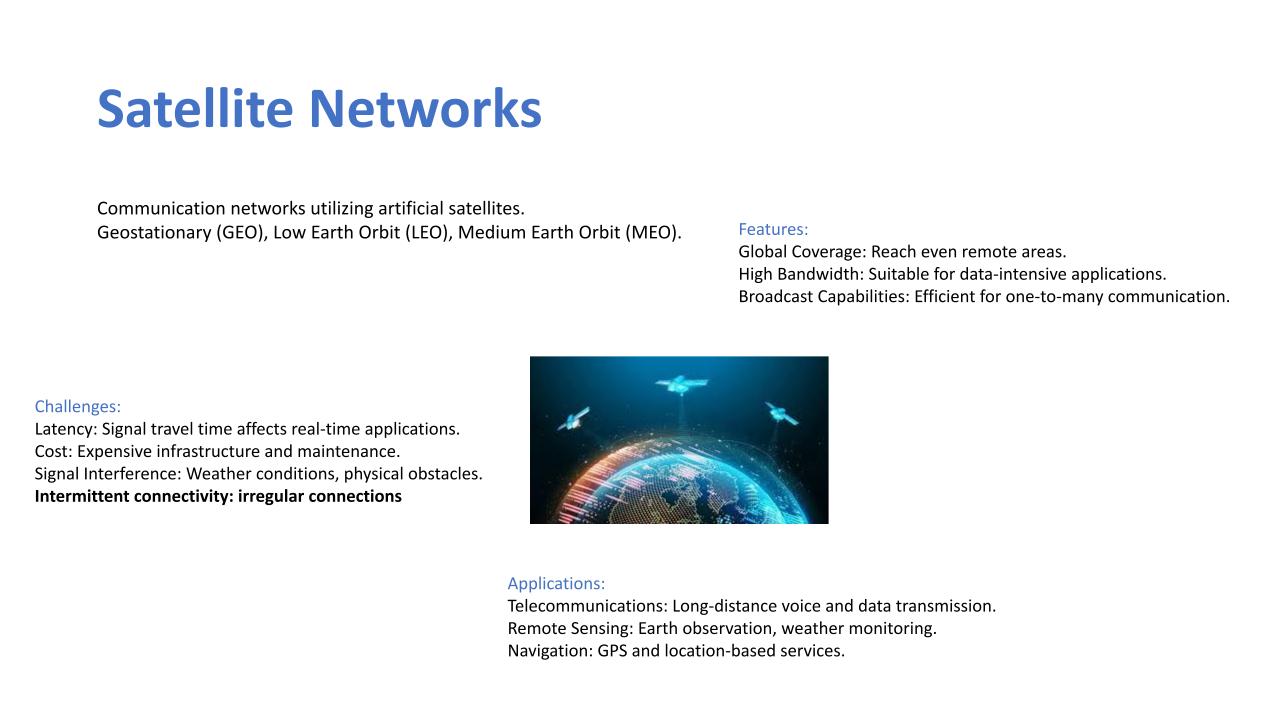
For an effective communication to take place, two bodies are required, one for sending and then the other for receiving. This same characteristic is a common factor in satellite communication. Not only is it required for two satellites to communicate effectively, it can also be that one satellite communicates with many, reaching global coverage especially remote areas also. Satellites have high bandwidth capabilities which is suitable for data intensive applications. In this work, we make reference to communication network which utilizes artificial satellites. Here, we continue to consider the satellite constellation consisting of two low earth-orbit satellites, which is the LEO satellite, one medium earth-orbit satellite, which is the MEO satellite, and then one geostationary-orbit satellite which is the GEO satellite, each of which the real-time location was obtained from CelesTrak, and then we visualized it using our tool which we developed. It is also worthy to note the challenges associated with satellite communication, which include latency, cost, signal interference, and intermittent connectivity. These are the major challenges that are associated with satellite communication. The signal interference could be due to the distance, weather conditions or physical obstacles while the cost of maintaining such expensive infrastructures also pose an issue. We see also that the signal travel time affects real-time applications were a quick response is needed for operations. Signal interference may be probably due to irregularities of movement or space debris or whatever you may have in space or along the way of the line of sight.
|
 IEEE/ICACT20240287 Slide.02
[Big Slide]