 |
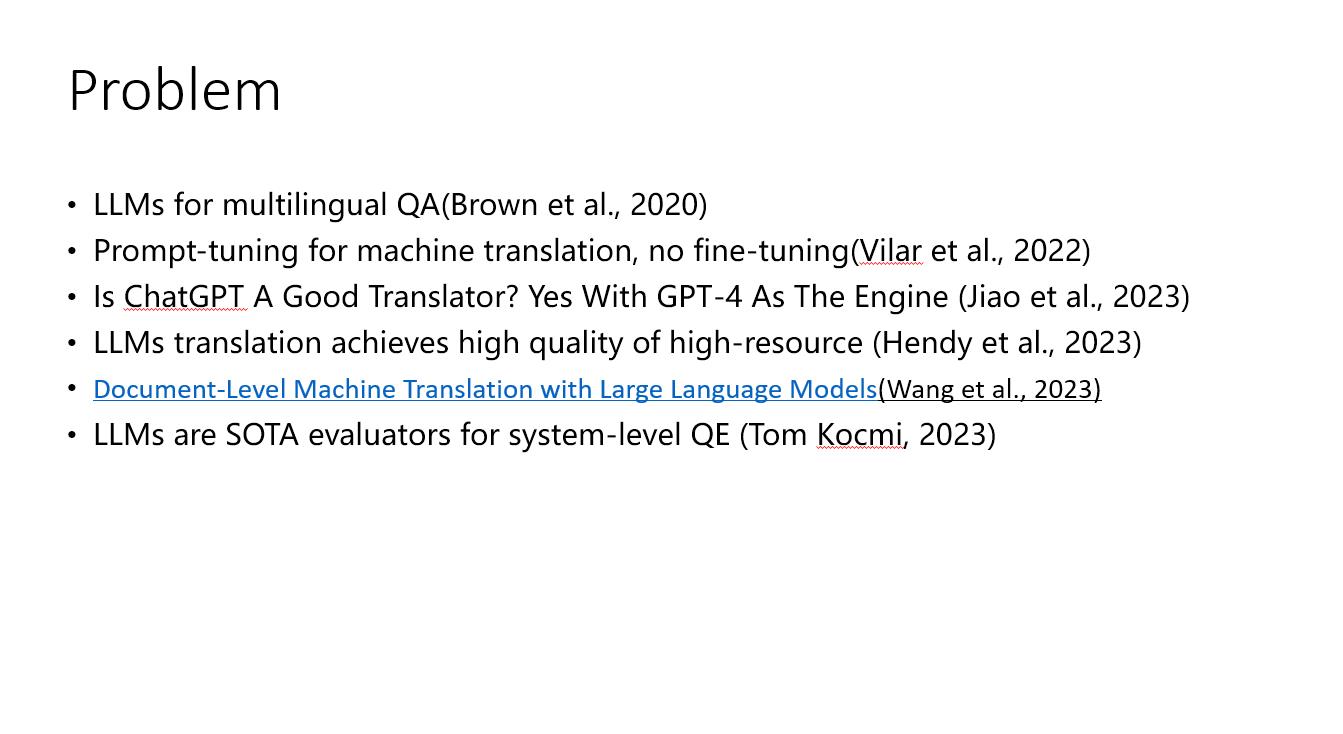
Recent research has shown increasing promise in adapting large language models (LLMs) for translation and translation quality estimation tasks. Brown et al. (2020) first demonstrated LLMs' effectiveness for multilingual question answering. Vilar et al. (2022) then showed LLMs can reach high translation quality for some language pairs via prompt-tuning without full fine-tuning. Jiao et al. (2023) found that ChatGPT paired with GPT-4 engines approaches human translation quality on high-resource language pairs. Hendy et al. (2023) and Wang et al. (2023) further showed LLMs achieving state-of-the-art results for both sentence and document-level translation tasks. Finally, Tom Kocmi (2023) demonstrated LLMs serve as highly effective system-level evaluator models for quality estimation, outperforming past approaches. Together these works highlight adaptable abilities of LLMs for translation and evaluation, opening promising avenues for continued investigation of knowledge-intensive, interpretable language processing. |
 IEEE/ICACT20240321 Slide.02
[Big Slide]