 |
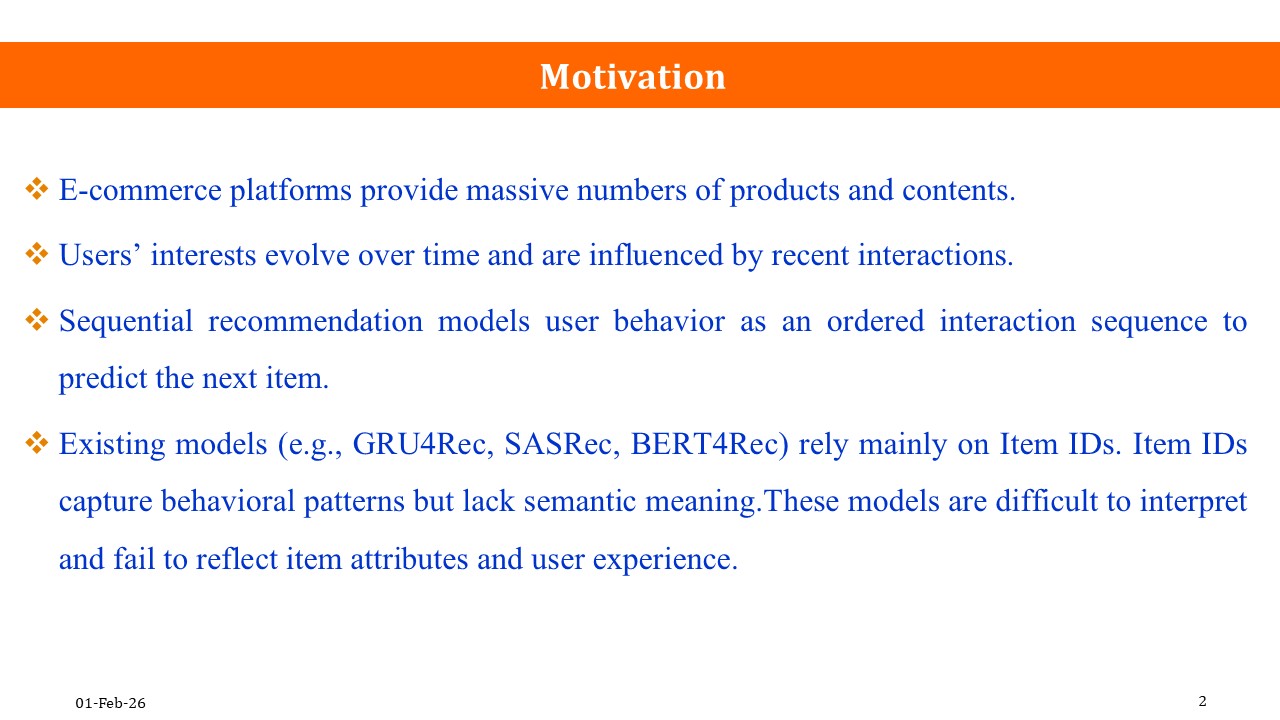
With the rapid growth of e-commerce platforms, users are exposed to an overwhelming number of products and contents.
In this context, recommender systems play a crucial role in helping users quickly find relevant items based on their historical interactions, while also improving sales and customer retention for businesses.
User preferences are not static; instead, they are strongly influenced by recent interactions. To capture this dynamic nature, sequential recommendation models represent user behavior as an ordered sequence of item interactions and aim to predict the next item a user is likely to interact with.
Existing sequential models such as GRU4Rec, SASRec, and BERT4Rec have shown strong performance by modeling short-term and long-term dependencies. However, these approaches rely mainly on item IDs. While item IDs are effective for capturing behavioral patterns, they lack semantic meaning, making the models difficult to interpret and unable to reflect item attributes or user experience expressed in reviews.
|
 IEEE/ICACT20260275 Slide.02
[Big Slide]