 |
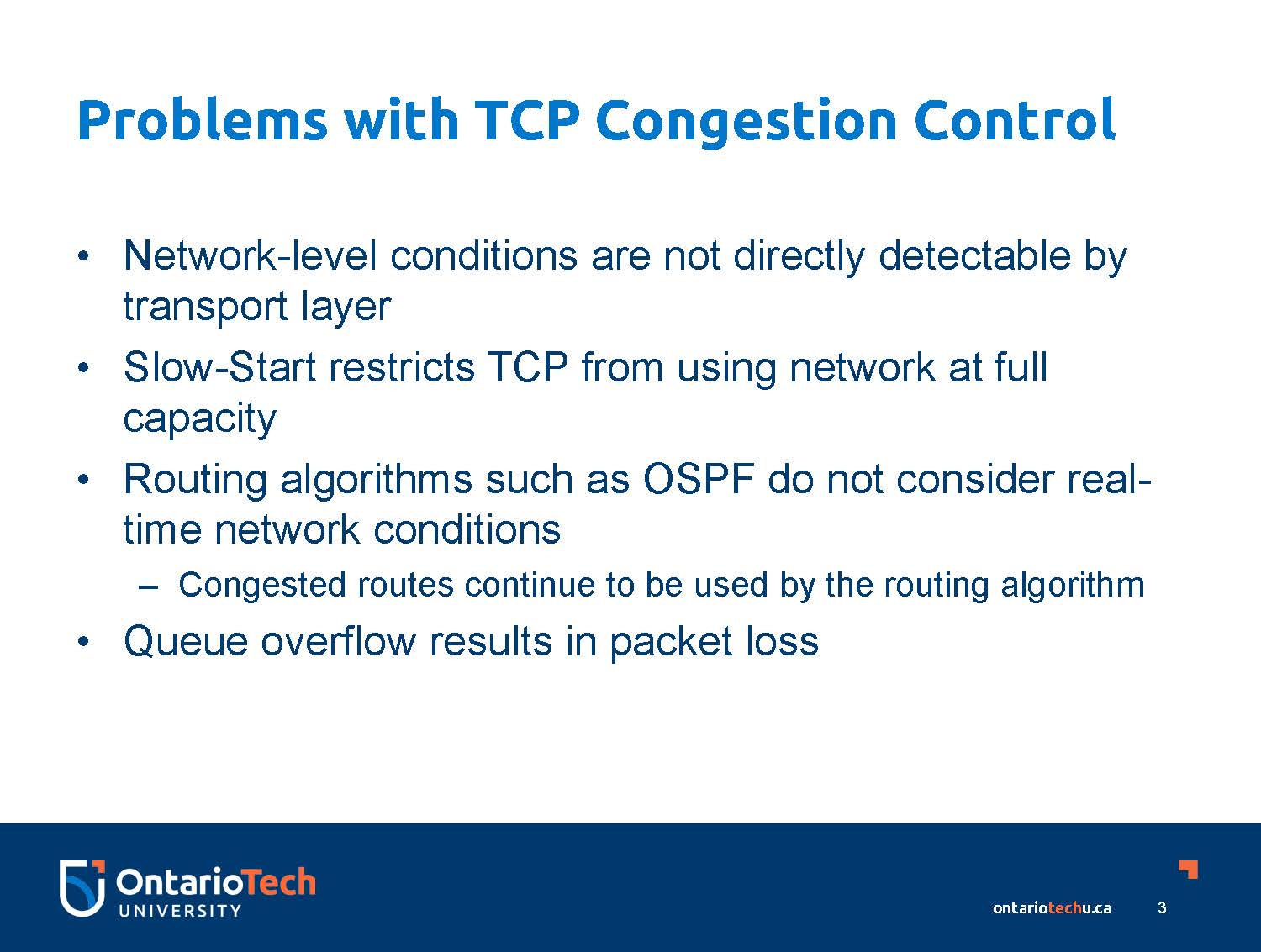
TCP is natively built to handle congestion; however, this
is done through controlling the traffic it sends while in a
congested state, as network conditions that attribute to congestion
over the network are not controllable by the Transport
layer. Some mechanisms to deal with congestion include slowstart,
where the network is slowly probed with data so to
not overwhelm the network, however in doing so the full
capacity of the network is not used. Routing
algorithms such as OSPF do not consider available bandwidth
on the link, so traffic will continually be routed over a link
either because that is the only path available, or because the
specific flow has been hashed to take a particular link. But
changes made on the network layer can directly impact TCP
performance, which will affect user experience. To add on,
if a queue on the router overflows because it is still waiting
to send traffic over the link, the packets will be dropped or
severely delayed resulting in a negative user experience.
|
 IEEE/ICACT20210131 Slide.03
[Big Slide]