 |
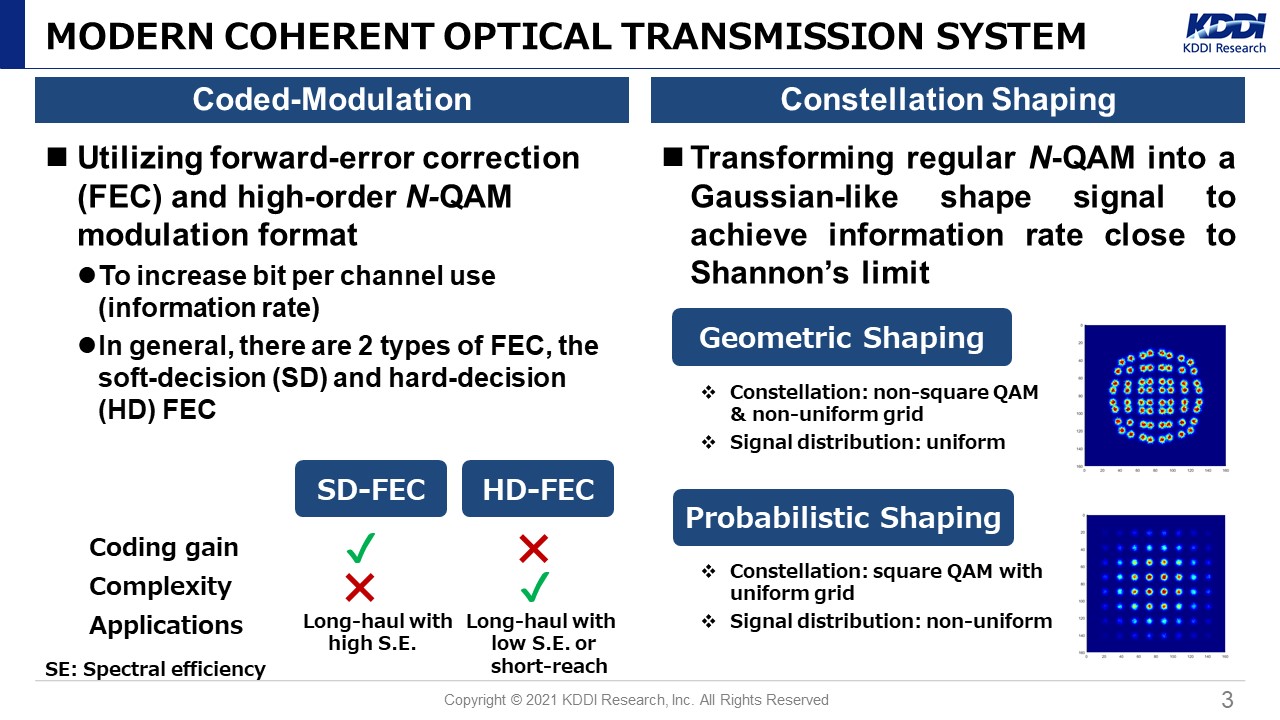
In modern coherent optical transmission technology, we aim to transmit the signal with as high spectral efficiency as we can achieved. On the other hand, we try to achieve the capacity of Shannon¡¯s limit. Two main technologies are being paid lots of attention, coded-modulation and constellation shaping. The coded-modulation is a combination of using forward error correction (FEC) and high-order QAM format. Basically, there are 2 types of FEC, the soft-decision (SD) and hard decision (HD) FEC. The SD-FEC is greater than HD-FEC in terms of the performance but it has the power consumption and complexity more than the HD-FEC. Therefore, in some scenarios such as a long-haul transmission with low S.E or short reach transmission which concern about cost and complexity, HD-FEC may be preferable. The constellation shaping is the technique to shape the transmitted signal into a Gaussian-like shape to achieve the SE close to Shannon¡¯s limit. There are generally two types of the constellation shaping. The first one is Geometric shaping which the signal distribution (or probability) is uniform whereas the constellation is not on the uniform grid of regular square N-QAM. The second one is the probabilistic shaping which the signal distribution is not uniform, but the constellation is on the regular square N-QAM grid. The difference is shown in figures in the right-hand side. |
 IEEE/ICACT20210252 Slide.03
[Big Slide]