 |
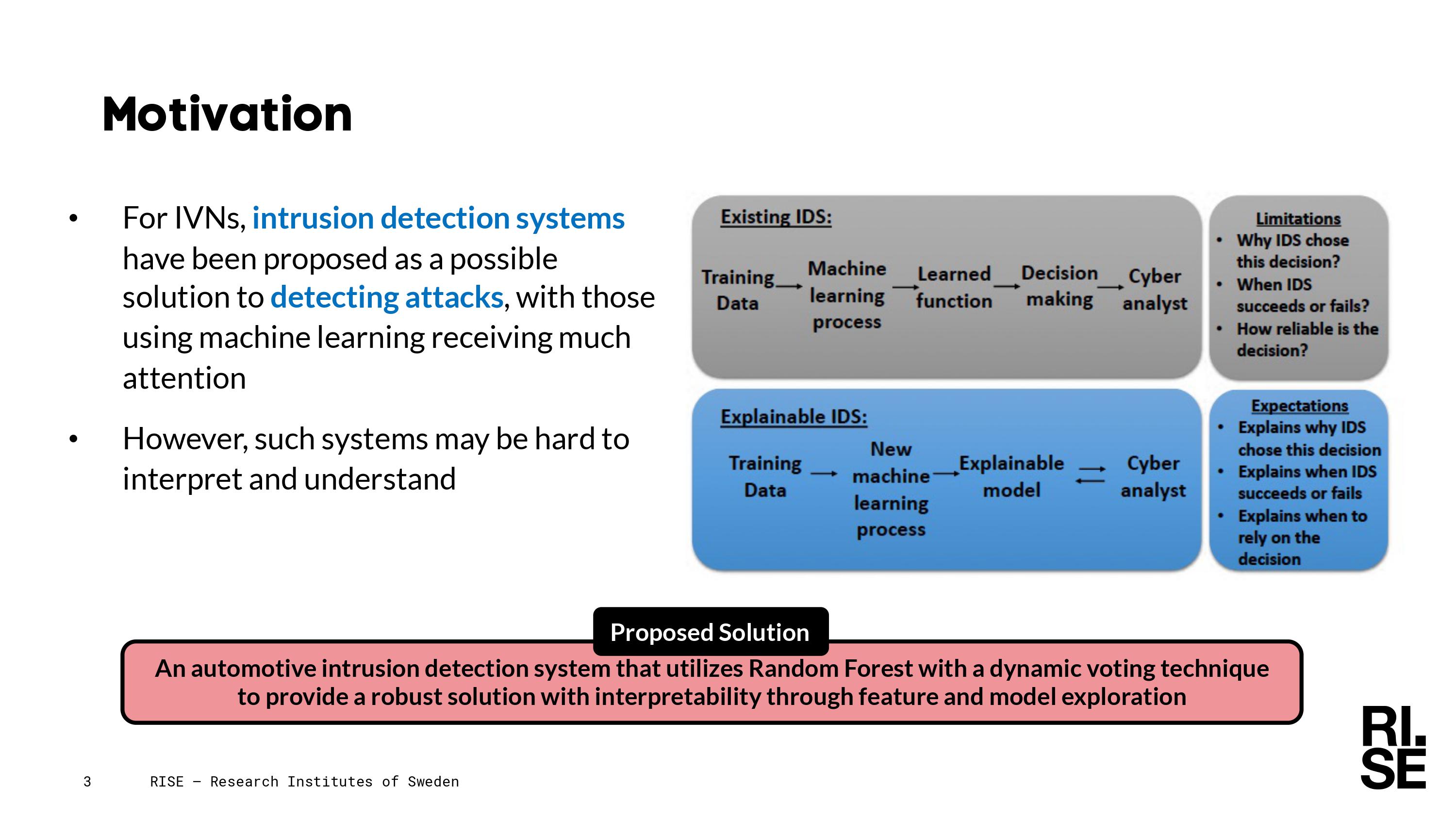
To solve this problem of attacks on the in-vehicle network, intrusion detection systems have been proposed to detect active attacks. Many intrusion detection solutions that utilize machine learning have been designed in the research community over the past years. However, a large portion of academic research in this field has not been converted to practical applications. One important reason may be that the decisions made by these systems are hard to interpret and understand. Existing IDS solutions don¡¯t answer the questions to why the IDS chose a certain decision, when it succeeds and when it fails, and how reliable the decision is. Therefore, we propose an automotive intrusion detection system that uses a dynamic voting technique to provide interpretability and explainability through feature and sub-model exploration. In particular, a set of random forest models are leveraged to find a robust solution to address the challenge.
|
 IEEE/ICACT20220035 Slide.03
[Big Slide]
[YouTube]