 |
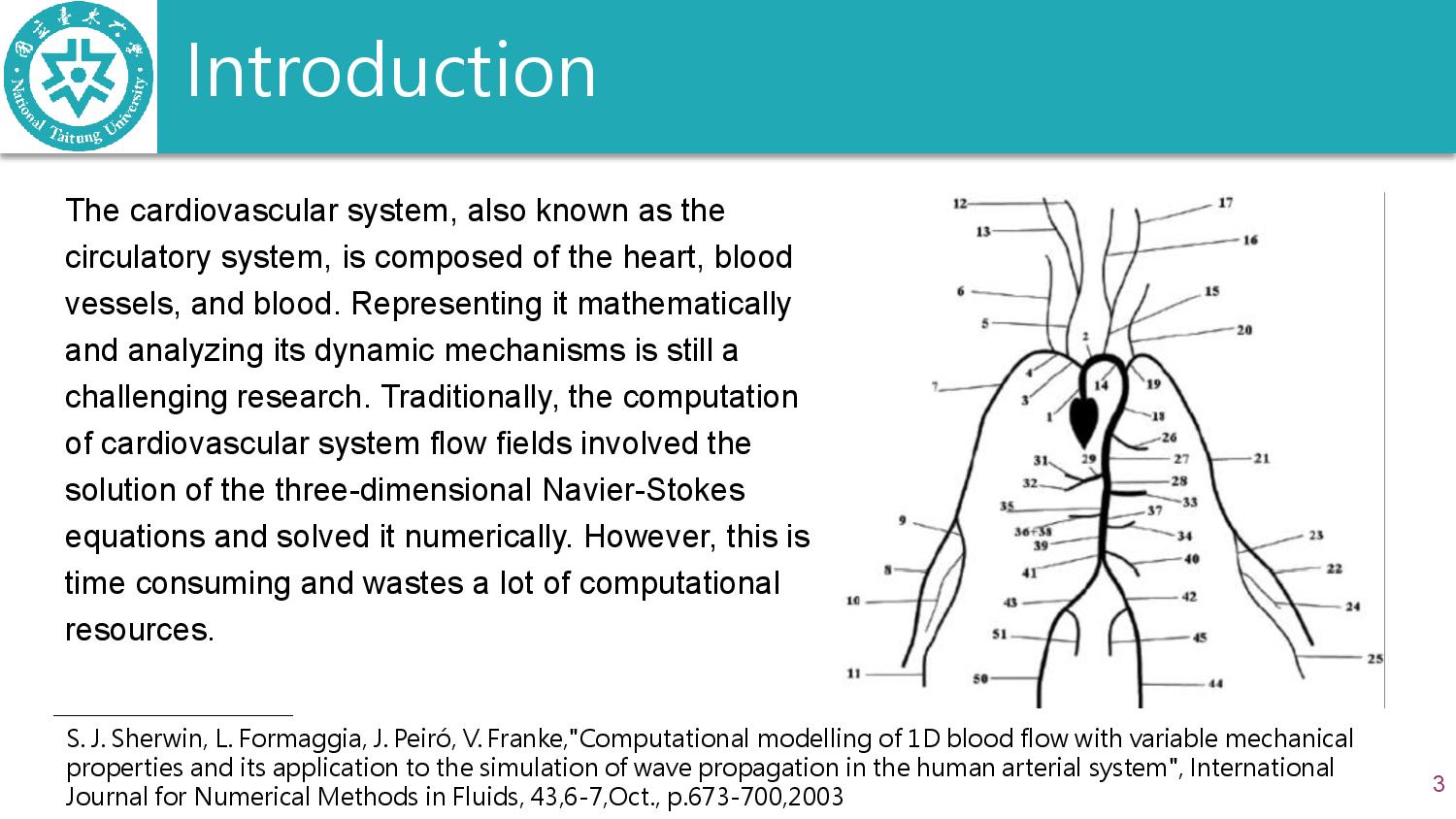
The cardiovascular system, also known as the circulatory system, is composed of the heart, blood vessels (arteries, veins, capillaries), and blood. Representing it mathematically and analyzing its dynamic mechanisms is still a challenging research. Traditionally, the computation of cardiovascular system flow fields involved the solution of the three-dimensional Navier-Stokes equations and solved it numerically. However, this is time consuming and wastes a lot of computational resources.
To simplify this problem, certain assumptions can be made, reducing it to a one-dimensional problem., thus, the axisymmetric Navier-Stokes equations. Axisymmetric equations may have a single point where the radius is zero making numerical solutions singularity.
In recent years, the development of Artificial Intelligence (AI) has been one of the hottest topics. Physics-informed Neural Networks (PINN), proposed by scholar M. Raissi, are a type of neural network that uses physical equations as computational constraints for solving partial differential equations. They belong to the supervised learning category. This network utilizes data-driven training, learning through loss functions described by partial differential equations. During the training process, PINN benefits from the constraints imposed by physical equations, enabling it to learn fundamental physical laws such as mass and momentum conservation. In recent years, PINN has gradually become a focal point in machine learning and computational fluid dynamics, achieving significant progress in both theory and applications.
To enhance the performance of computation of cardiovascular system flow fields, the systems can be treated as 1D tube like structures and PINN method is adopted for simulations. Further, we solve several preambles to demonstrate obtaining the results accuracy and efficiency.
|
 IEEE/ICACT20240208 Slide.03
[Big Slide]
[YouTube]