 |
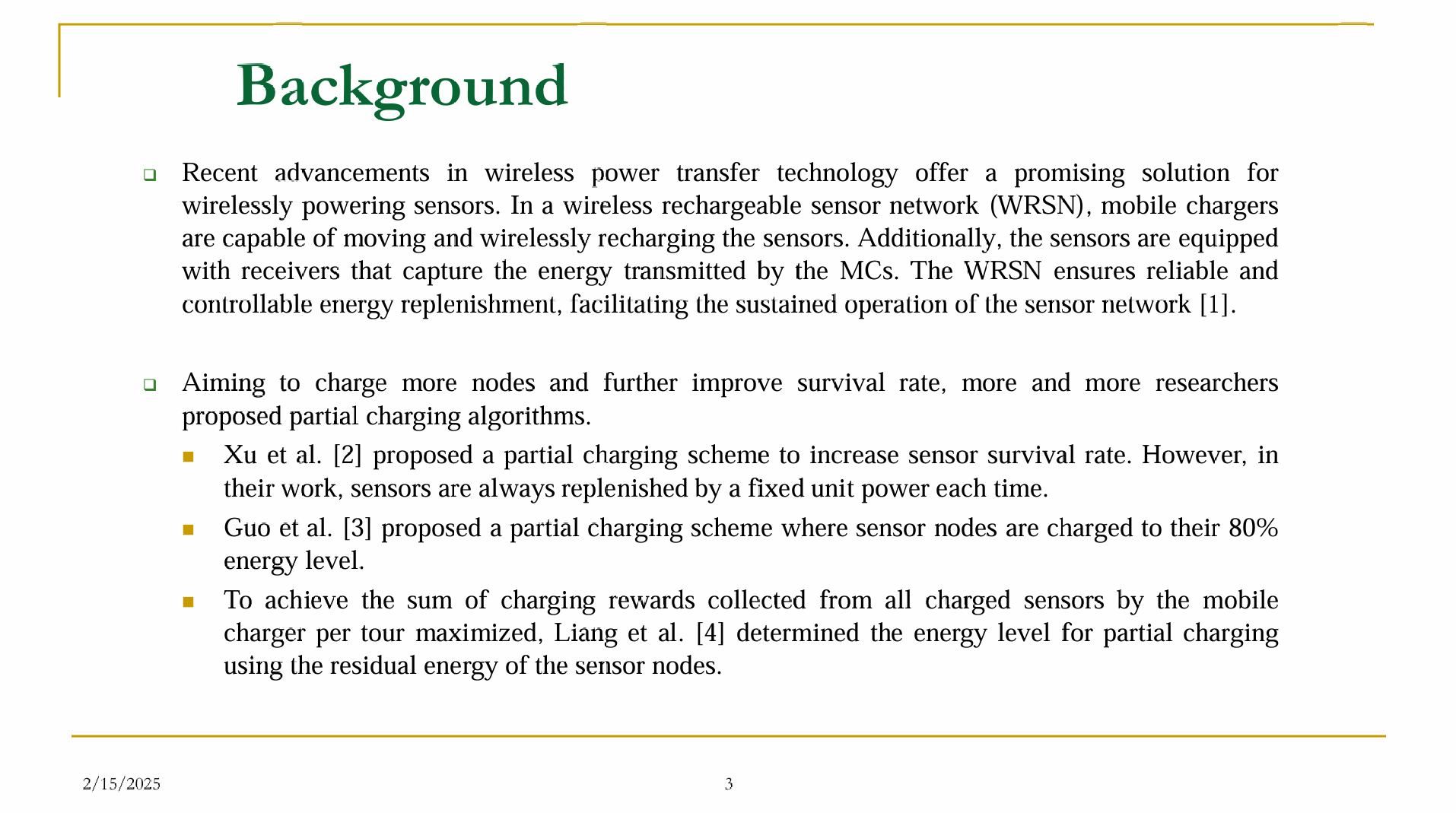
First, let¡¯s start with the background of this paper. Recent advancements in wireless power transfer technology offer a promising solution for wirelessly powering sensors. In a wireless rechargeable sensor network (WRSN), mobile chargers are capable of moving and wirelessly recharging the sensors. Additionally, the sensors are equipped with receivers that capture the energy transmitted by the MCs. The WRSN ensures reliable and controllable energy replenishment, facilitating the sustained operation of the sensor network. Aiming to charge more nodes and further improve survival rate, more and more researchers proposed partial charging algorithms. Xu et al. proposed a partial charging scheme to increase sensor survival rate. However, in their work, sensors are always replenished by a fixed unit power each time. Guo et al. proposed a partial charging scheme where sensor nodes are charged to their 80% energy level. To achieve the sum of charging rewards collected from all charged sensors by the mobile charger per tour maximized, Liang et al. determined the energy level for partial charging using the residual energy of the sensor nodes.
|
 IEEE/ICACT20250091 Slide.03
[Big Slide]