 |
MPEG Immersive Video, or MIV, is a standard developed by the Moving Picture Experts Group (MPEG) to efficiently represent immersive 3D scenes using multiple video views.
Unlike traditional 2D video coding, MIV enables users to navigate within a scene and change viewpoints, enhancing realism and interactivity.
There is a reference software called TMIV that supports MIV.
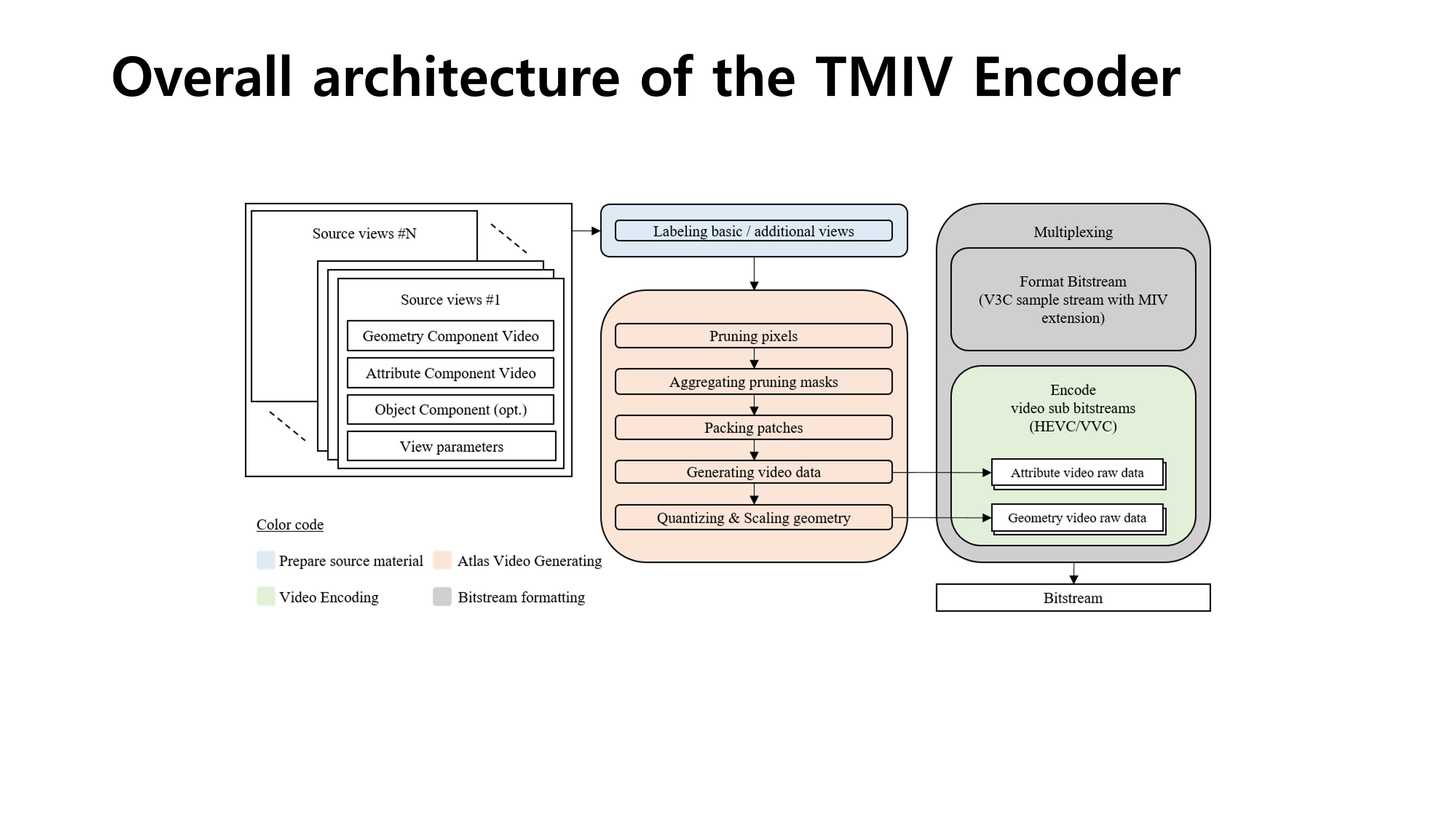
TMIV takes multiple source views as input, including geometry, attributes, object component video, and various parameters related to the views.
TMIV labels the input source videos as basic views and additional views.
TMIV prunes pixels in the additional views while considering redundancy, based on the basic views. The unpruned pixels are then used to create a mask, which is aggregated and formed into patches.
Then, the patches are packed to generate an atlas video. Considering video coding efficiency, the atlas video is then quantized and scaled.
The generated atlas video is encoded using HEVC or VVC to produce a bitstream, which is then multiplexed together with other auxiliary bitstreams.
|
 IEEE/ICACT20250139 Slide.03
[Big Slide]