 |
Let me begin with the motivation behind this work.
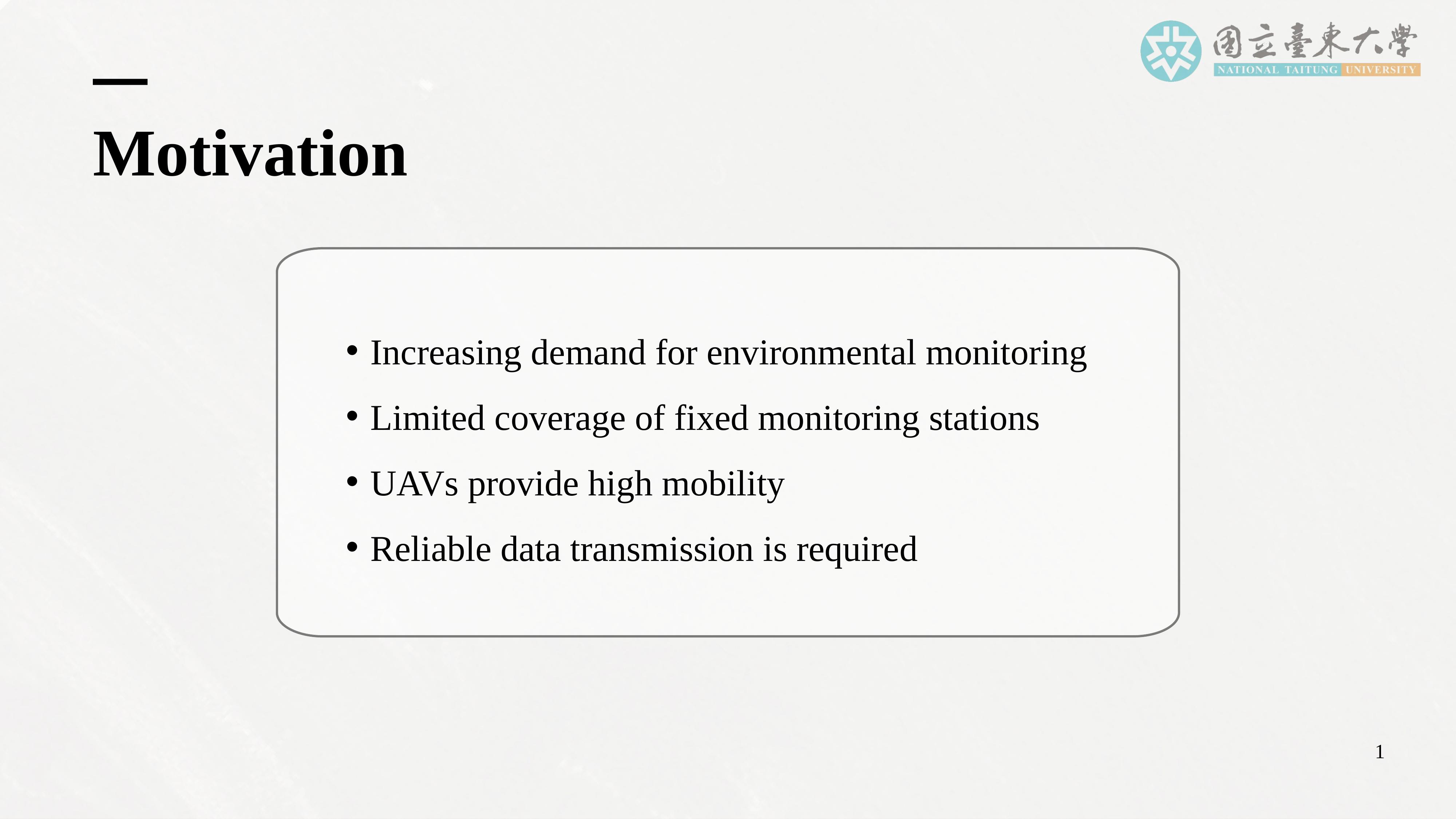
In recent years, environmental pollution and climate change have significantly increased the demand for real-time, flexible, and high-resolution environmental monitoring. Traditional fixed monitoring stations provide stable and reliable data, but they suffer from several limitations. First, their spatial coverage is limited. Second, they lack deployment flexibility. And third, they cannot quickly respond to sudden events such as air pollution spikes, forest fires, or industrial accidents.
Uncrewed Aerial Vehicles, or UAVs, offer a promising alternative. UAVs have high mobility, can be rapidly deployed, and can dynamically adjust their monitoring areas. As a result, UAVs can complement fixed stations and enhance environmental monitoring capabilities, especially in remote or rapidly changing environments.
However, UAV-based monitoring also introduces new challenges. One of the most critical challenges is reliable data transmission. Environmental sensing is only useful if the collected data can be transmitted back to a ground station in a timely, reliable, and energy-efficient manner.
This leads us to Integrated Sensing and Communication, or ISAC. ISAC aims to use a single waveform or signal for both sensing and communication. While ISAC improves spectrum efficiency and system integration, it also introduces trade-offs between sensing performance, communication reliability, and resource allocation.
In UAV-based systems, these trade-offs become even more complex because of mobility, dynamic distance changes, limited onboard energy, and varying communication conditions.
Therefore, our main motivation is to build a simulation framework that can quantitatively analyze how distance and bandwidth affect communication performance and energy efficiency in a UAV-ISAC-based environmental monitoring system.
|
 IEEE/ICACT20260251 Slide.03
[Big Slide]