 |
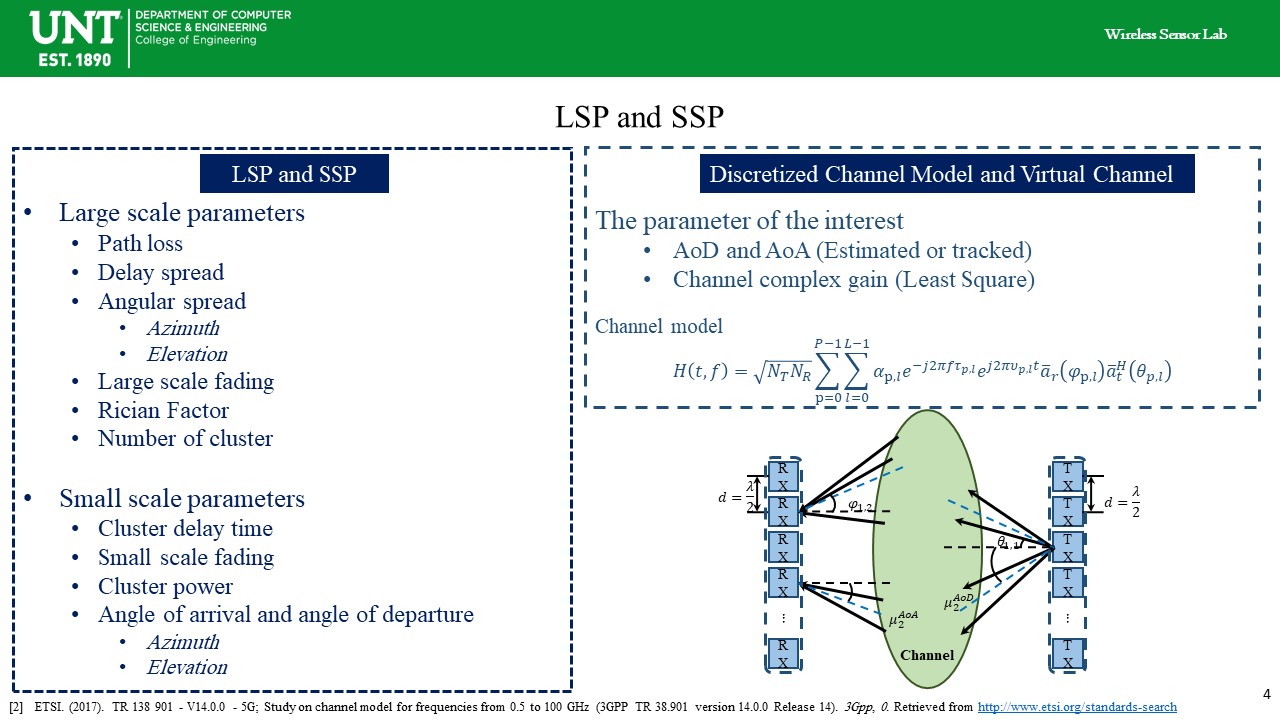
To understand millimeter-wave, we need to model the millimeter-wave channel properly to reflect its propagation characteristics. The large-scale behavior of the channel varies over longer distances, for example, in the order of a couple of meters. The large scale behavior is parameterized using the free-space path loss, delay spread of the channel, angular spread, etc. However, the communication between the transmitter and receiver takes place through multiple paths. And, the multiple paths will interfere constructively and destructively, also known as small-scale fading. To model multipath communication, each path is parameterized using small-scale parameters. The small-scale parameters we are using in this work are the azimuth angle of departure AoD, the azimuth angle of arrival AoA, and the complex gains. The channel transfer function as shown here is constructed using the delay and Doppler shift contribution of the paths, and the transmitter and receiver steering vectors formed using the angle of departure and angle of arrival. As a result, to identify the channel, one needs to estimate the small-scale parameters. Particularly, we are interested in estimating AoD, AoA, and complex channel gain.
|
 IEEE/ICACT20210129 Slide.04
[Big Slide]