 |
Now, I will go through the related works.
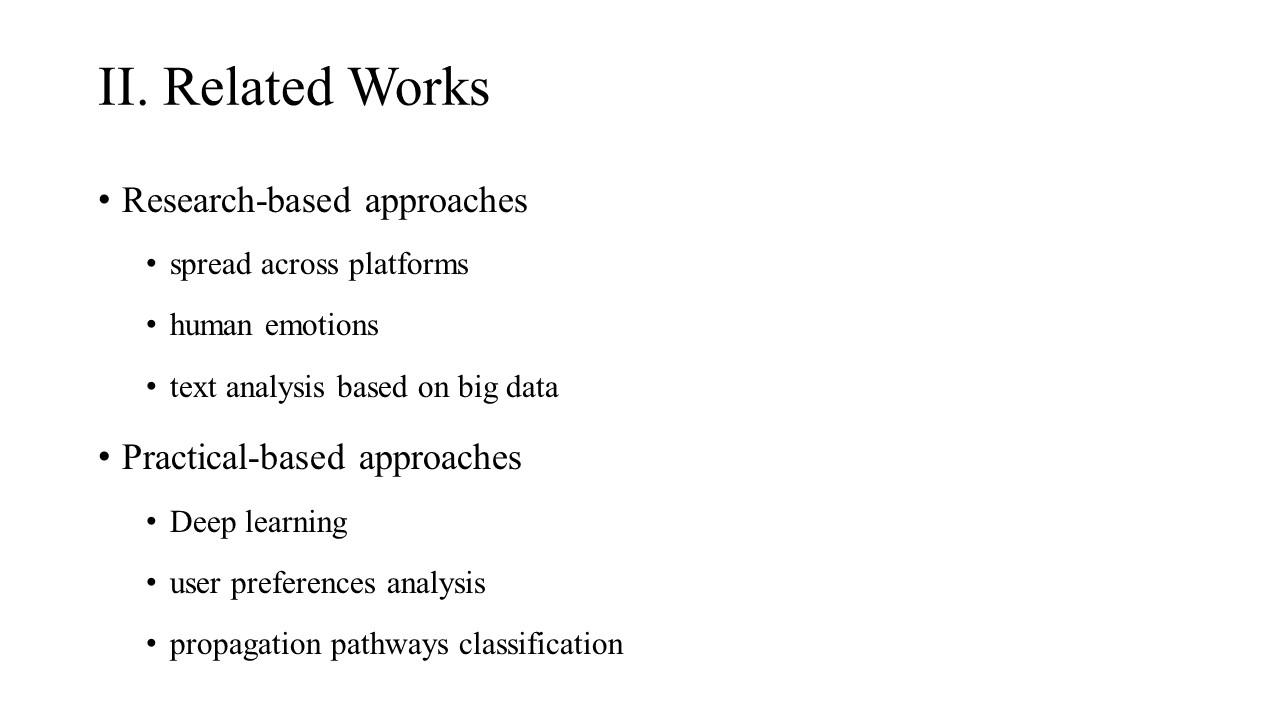
Lin [6] explores the spread of fake news on different social platforms from the viewpoint of media convergence. Vosoughi et al. [7] focus on human emotions to analyze the factors that affect dissemination of disinformation. Ip [8] analyzes the factors that drive the spreading of fake news across platforms and proposes some possible solutions. Fu and Tao [9] explore the dissemination of disinformation on social media by using text analysis based on big data on Internet memes [10], Cheng [11] integrates STS (science and technology studies) with methods in communication research to explore how disinformation is spread on social platforms quickly. Cheng [12] proposes a framework involving multiple approaches to analyze the circulation and dissemination patterns of disinformation on social media. Wu and Liu [13] combine an LSTM-RNN (the Long Short-Term Memory cells into the RNN model) with an embedding method to classify propagation pathways of a message. Dou et al. [14] analyze user preferences for the purposes of detection of disinformation. Shu et al. [15] established a fake news database FakeNewsNet to promote research into fake news and this database facilitates potential applications on fake news study on social media.
|
 IEEE/ICACT20220114 Slide.04
[Big Slide]
[YouTube]