 |
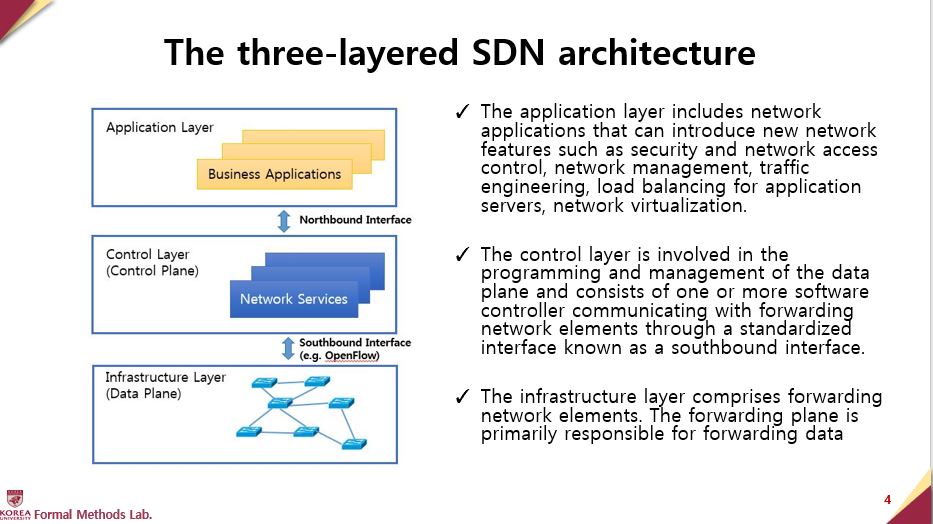
This picture shows the SDN framework, which consists of three layers: the application layer, the control layer, and Infrastructure layer.
The application layer includes network applications that can introduce new network features such as security and manageability, provide forwarding schemes, or assist the control layer in the network configuration. The application layer can provide appropriate guidance for the control layer by obtaining an abstracted global view of the network management and traffic engineering, load balancing for application servers, load balancing for application servers, security and network access control, network testing, debugging and verification, inter-domain routing, and network virtualization. The interface between the application layer and the control layer is known as the northbound interface.
In the lower layer, the control plane is found. This is involved in the programming and management of the forwarding plane. In order to achieve this, it uses information provided by the forwarding plane. In order to achieve this, it uses information provided by the forwarding plane and defines network operations and routing. It consists through a standardized interface known as a southbound interface. OpenFlow, one of the most commonly used southbound interfaces, primarily considers switch
|
 IEEE/ICACT20220362 Slide.04
[Big Slide]
[YouTube]
IEEE/ICACT20220362 Slide.04
[Big Slide]
[YouTube]