 |
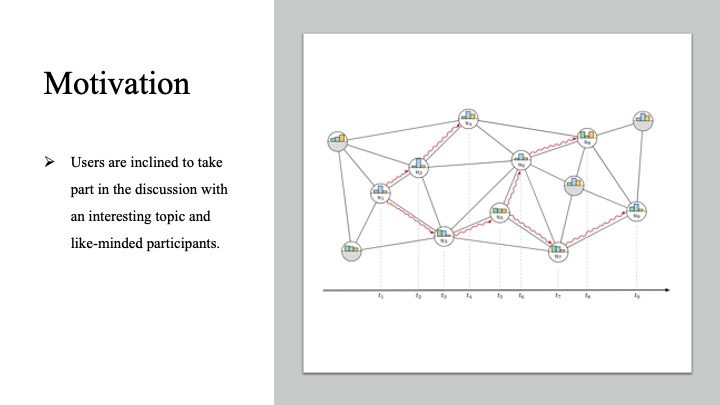
In the context of information diffusion, users are inclined to take part in the discussion with an interesting topic and like-minded participants. Even though many valuable insights and observations have been proposed by previous advanced research, some of which try to characterize the dynamic propagation based on individual interests, these methods still cannot explain the underlying propagation mechanism because they do not properly characterize the diverse interests of users on social network. As shown in this Figure, there are two kinds of networks. The first one is a static social network with solid lines that represent strong following relationships. Users in the static network are marked with discrete categorical histograms where each bar represents the interest intensity in the corresponding category. Taking user $u_1$ as an example, there are three kinds of interests in total, and $u_1$'s interests are mainly concentrated in the second blue category. The second network represents the diffusion topology of a specific message, in which the forwarding interactions between users are denoted by directed red squiggly lines. Initially, user $u_1$ posts a source message $m_s$ at time $t_1$, which is related to the blue topic. It is continuously forwarded by others who are interested in the blue topic, such as $u_2, u_4$ and $u_9$. Focus on user $u_6$ at time $t_6$. Although $u_6$ forwards $u_5$'s message and participates in the propagation process, it is incomplete to only consider $u_5$'s incentive for $u_6$'s forwarding behavior. Based on the strong following relationship and stable recommendation mechanism on online social platforms, $u_6$ usually has seen the participation of $u_2, u_3$ and $u_4$, who are directly connected to $u_6$ in the static network $G$ and participate in the cascade before $t_6$. These influences also affect $u_6$ to a certain extent and contribute to $u_6$'s forwarding behavior. Since individual interests essential roles in information cascade formation, it is crucial for cascade prediction to take account of it. |
 IEEE/ICACT20230179 Slide.04
[Big Slide]
[YouTube]