 |
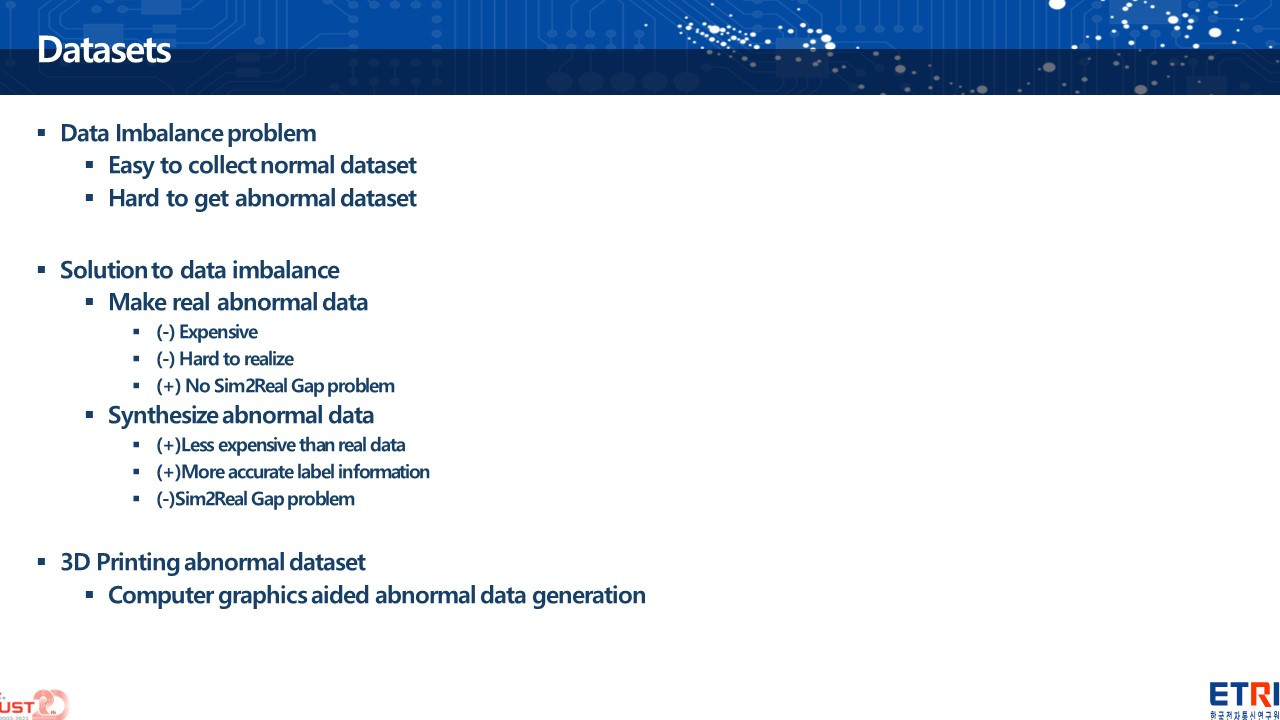
This slide addresses the issue of data imbalance in datasets used for anomaly detection in additive manufacturing. It's easier to collect normal data compared to abnormal data, which is scarce and harder to gather. The slide suggests two solutions to this problem:
Making real abnormal data, which although effective, is expensive and challenging to realize. However, it does not suffer from the simulation-to-reality (Sim2Real) gap, which is the difference between simulated and real-world data.
Synthesizing abnormal data, which is less expensive and provides more accurate label information but comes with the downside of the Sim2Real gap problem.
Finally, the slide proposes using computer graphics to aid in the generation of abnormal datasets for 3D printing, which can help to mitigate the data imbalance issue by creating realistic abnormal data without the associated high costs or practical difficulties of capturing real-world anomalies. |
 IEEE/ICACT20240043 Slide.04
[Big Slide]