 |
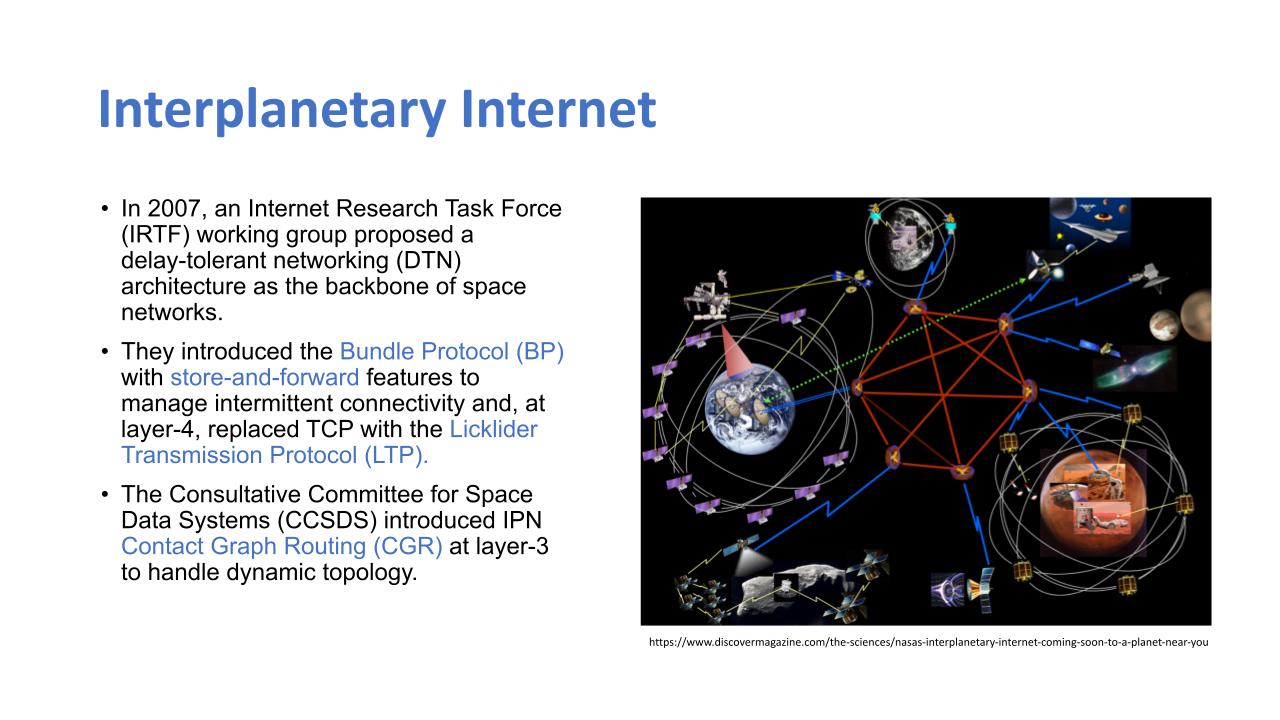
With the traditional transport and network layer which we are used to here on earth, the technologies are not suitable for space networks, especially for interplanetary networks. These challenges actually have resulted to several novel approaches intended to address the challenges of space network as earlier mentioned in the previous slide. In 2007 an internet research task force (IRTF) proposed a delay tolerance network as the backbone of space network which is an
improvement of the open systems interconnection model which is the OSI model which we're quite familiar with as the regular traditional network. Here, the study aimed to restructure existing model so as to achieve the DTN architecture as we now know it to be. This restructuring involves the introduction of the bundle protocol which has the store and forward features. The store forward features actually helps to keep/hold in message till when there is a line of sight or when the receiver is actually in sight for them to receive the data which we refer to as the contact time. Instead of having to send the message as opposed to the regular transmission on the traditional network the bundle protocol helps to store the message until when there is contact between both nodes before it then transmits the data. The transmission control protocol also which is the TCP protocol at the layer 4 of the traditional network was replaced with the licklider transmission protocol which was used to reduce the acknowledgement traffic over the network. Subsequently the consultative committee for space data systems which is the CCSDS introduced the IPN contact graph routing at the layer 3 to avoid dynamic topology and find the sources and also it helps to find the shortest path in space unlike the traditional OSPF routing protocol which we are used. The contact graph routing being an improvement of the OSPF deals with a deterministic approach for data transmission. Once there is a contact between two nodes, a link is set and the bundles are forwarded, without which bundles will be stored at the sending node until a contact is made. All these restructuring combine to give what we now know as the delay tolerance network architecture
|
 IEEE/ICACT20240287 Slide.04
[Big Slide]