 |
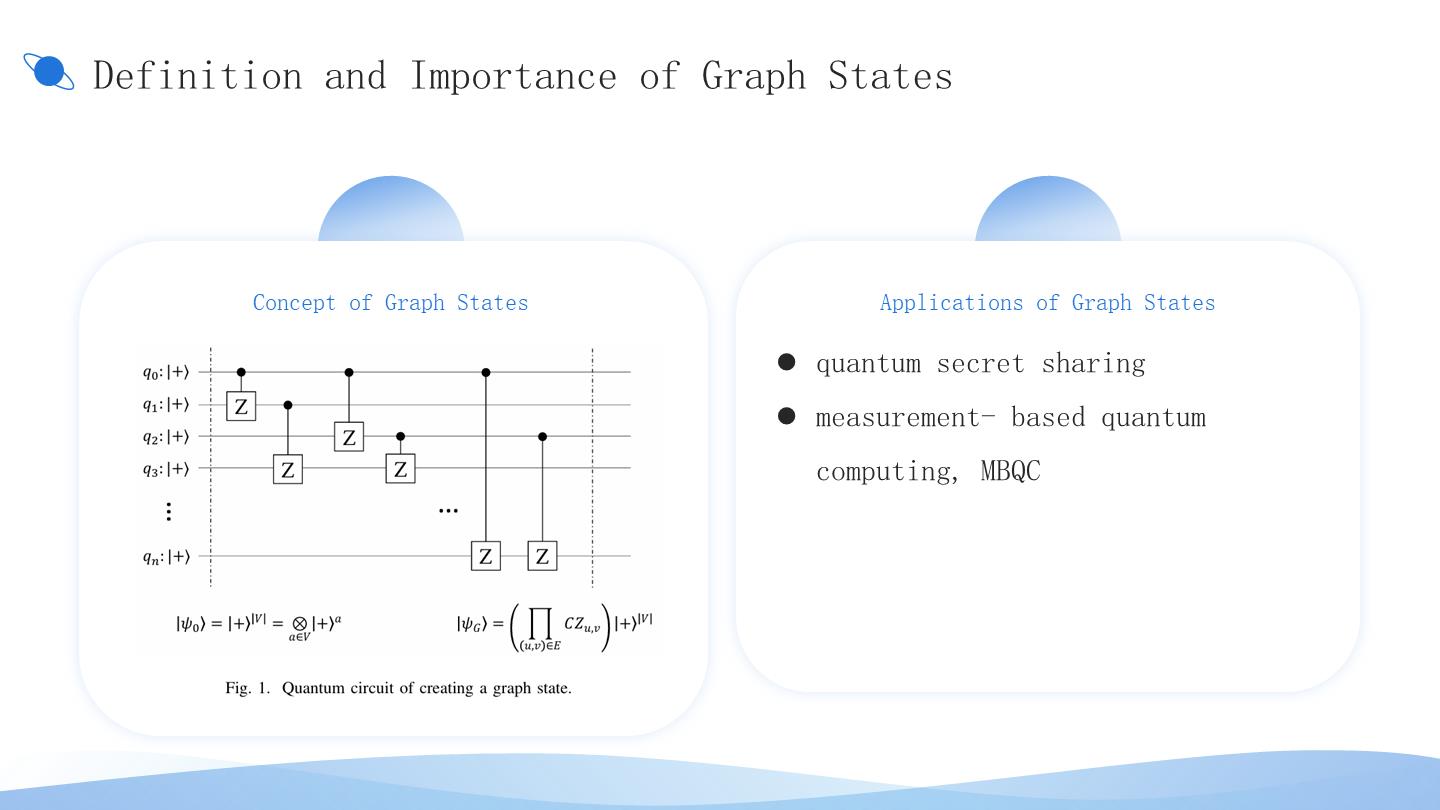
Graph states are a special class of multi- particle entangled quantum states represented by a graph to illustrate entanglement relationships among qubits. Both GHZ states and cluster states are types of graph states. These states are crucial in quantum secret sharing, measurement- based quantum computing, and quantum metrology, making them a significant quantum resource.
For example, to create a n- qubit graph state, we need to create n states of |+⟩ and perform controlled Z gate operations on all pairs of vertices belonging to E in graph G.
Graph states enable unique functionalities in quantum networks, such as quantum secret sharing, which allows secure distribution of information among multiple parties. They also play a vital role in measurement- based quantum computing, providing a platform for performing complex computations using entangled states.
For instance, Adrian Keet et al. proposed using graph states for quantum secret sharing, and Massimiliano Proietti et al. introduced an MBQC algorithm to solve the maximum K- cut problem using graph states.
|
 IEEE/ICACT20250011 Slide.04
[Big Slide]
[YouTube]