 |
Let¡¯s begin with an introduction to indoor positioning systems. As you know, they play a crucial role in various applications, ranging from navigation in large facilities like shopping malls and airports to tracking assets in warehouses and cleanrooms.
While GNSS provides accurate outdoor positioning, its signals struggle indoors due to interference from walls and other structures. As a result, alternative methods such as signal-based indoor positioning have been developed, utilizing technologies like Wi-Fi, Bluetooth, and Ultra-Wideband (UWB).
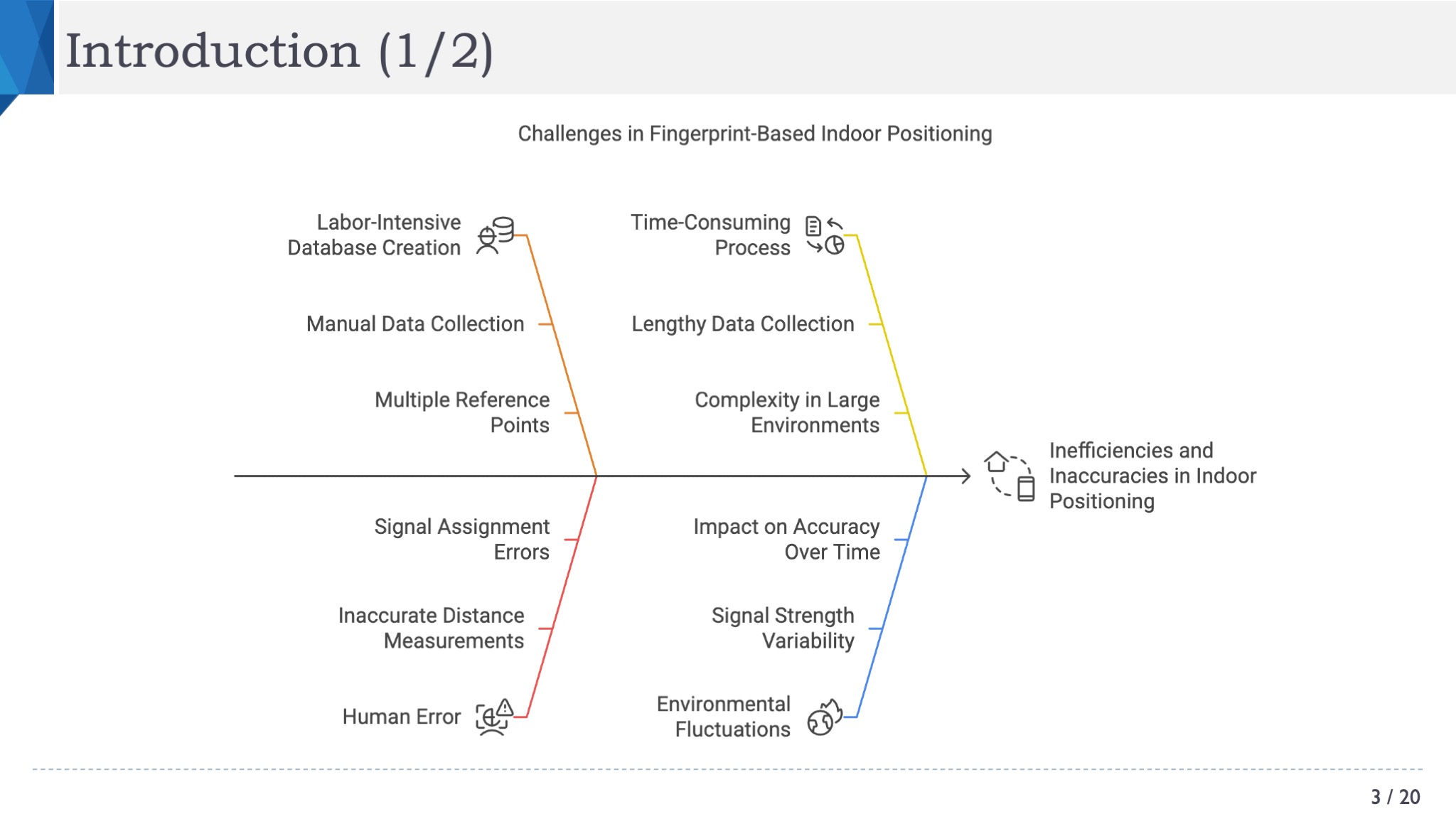
Despite their effectiveness, signal-based positioning systems have several limitations. The most notable challenges include the manual effort required to build a fingerprint database, fluctuations in signal strength due to environmental changes, and device dependency, where different hardware may lead to inconsistent results.
These factors significantly affect the accuracy and reliability of traditional indoor positioning systems, making them less effective in dynamic environments.
|
 IEEE/ICACT20250045 Slide.04
[Big Slide]
[YouTube]