 |
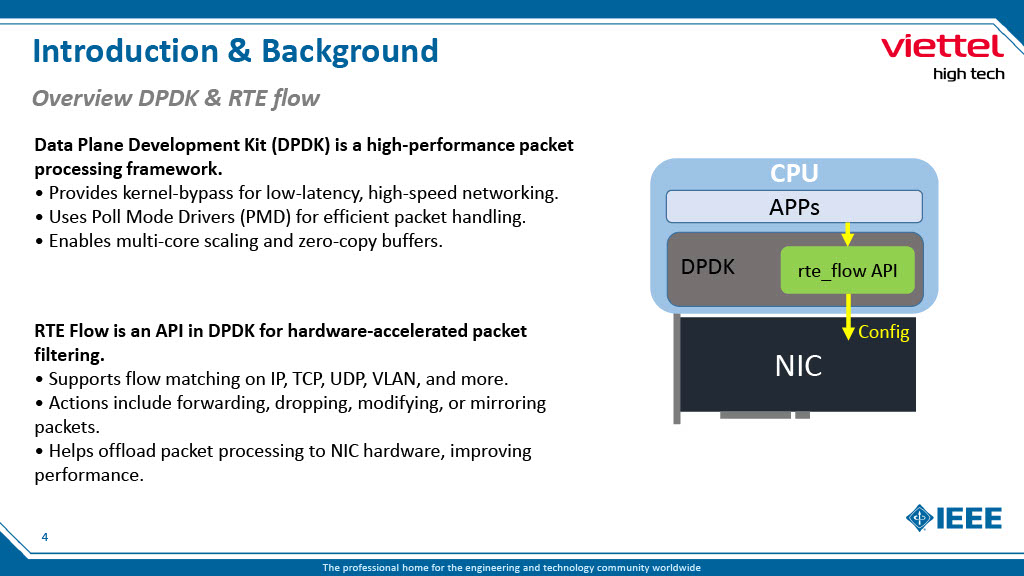
Data Plane Development Kit (DPDK) is a high-performance packet processing framework widely used in network applications. It provides the infrastructure needed to accelerate packet processing tasks, enabling faster, more efficient handling of network traffic.
Key Features of DPDK:
1. Kernel Bypass for Low-Latency, High-Speed Networking
DPDK enables direct access to hardware resources by bypassing the kernel, reducing the overhead typically caused by the operating system¡¯s networking stack..
2. Poll Mode Drivers (PMD) for Efficient Packet Handling
DPDK uses Poll Mode Drivers (PMD) to handle packet reception and transmission instead of relying on interrupts, enabling much faster and more efficient packet processing.
3. Multi-core Scaling
DPDK allows for multi-core scaling, which means that packet processing tasks can be distributed across multiple CPU cores.
4. Zero-Copy Buffers
DPDK implements zero-copy buffer management, which eliminates the need for data to be copied between the user space and kernel space. This reduces memory access overhead and speeds up the data transfer process, enhancing the overall efficiency of packet processing.
RTE Flow is a framework in DPDK designed for efficient, rule-based packet processing. By utilizing hardware acceleration, such as smartNICs, it offloads tasks from the CPU, enabling fast and scalable rule matching and action execution, which ultimately improves performance and reduces CPU load. In the next slide, I will provide an overview of the different types of smartNIC-based hardware architectures.
|
 IEEE/ICACT20250056 Slide.04
[Big Slide]