 |
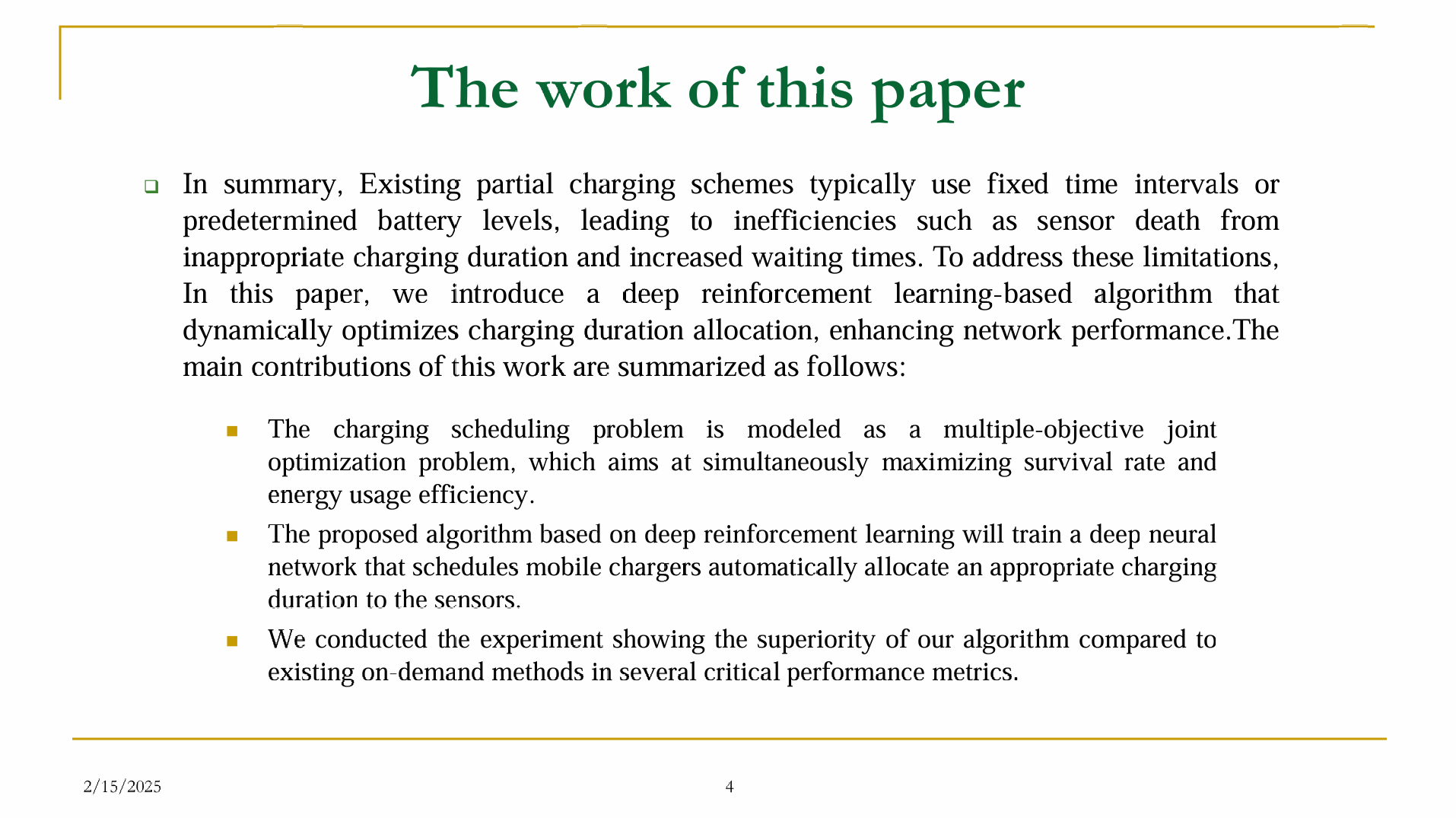
In summary, Existing partial charging schemes typically use fixed time intervals or predetermined battery levels, leading to inefficiencies such as sensor death from inappropriate charging duration and increased waiting times. To address these limitations, In this paper, we introduce a deep reinforcement learning-based algorithm that dynamically optimizes charging duration allocation, enhancing network performance.The main contributions of this work are summarized as follows: First, the charging scheduling problem is modeled as a multiple-objective joint optimization problem, which aims at simultaneously maximizing survival rate and energy usage efficiency. Second, the proposed algorithm based on deep reinforcement learning will train a deep neural network that schedules mobile chargers automatically allocate an appropriate charging duration to the sensors. Third, We conducted the experiment showing the superiority of our algorithm compared to existing on-demand methods in several critical performance metrics.
|
 IEEE/ICACT20250091 Slide.04
[Big Slide]