 |
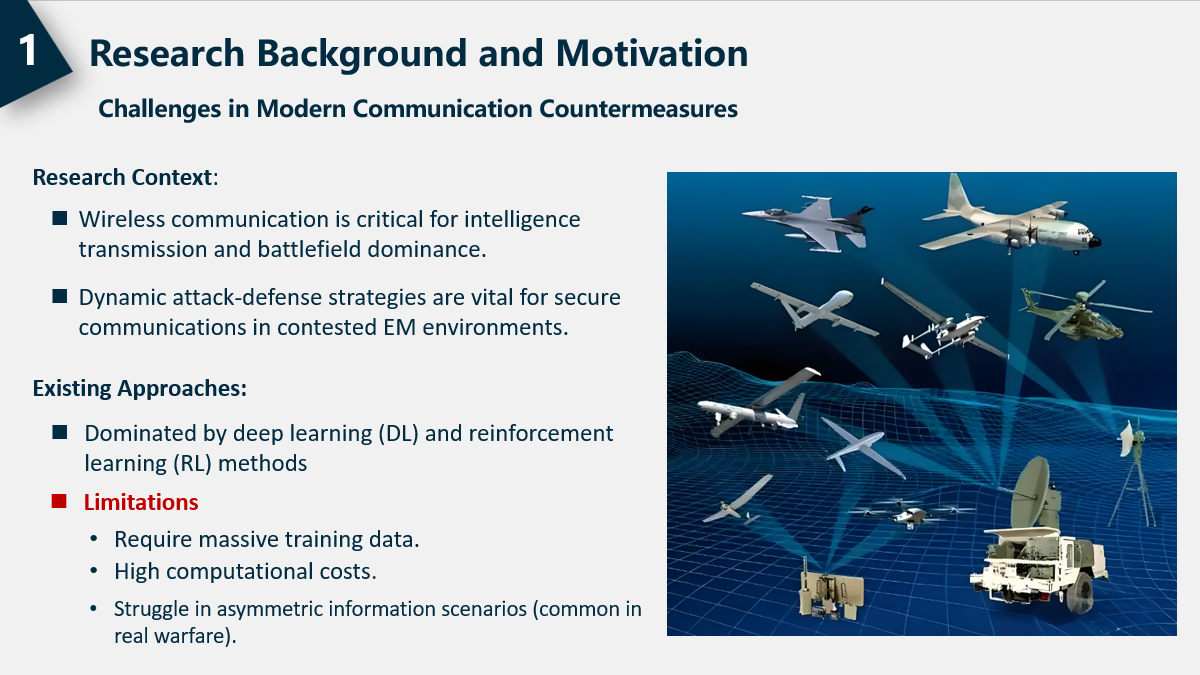
Wireless communication plays a pivotal role in intelligent transmission and battlefield dominance. However, the modern electromagnetic (EM) environment has become highly complex, and various communication countermeasure techniques are constantly emerging. Under such conditions, making real-time and adaptive decisions on attack and defense strategies is essential to ensure secure communications.
The existing methods for solving this problem primarily rely on deep learning (DL) and reinforcement learning (RL). While effective, these methods face three major limitations:
First, DL/RL models require massive datasets, which are difficult to obtain in real warfare.
Second, deep learning and reinforcement learning models demand powerful hardware. Deploying these models in real-time would drain resources, slow down decision-making, or even fail entirely under field conditions.
Third, in real combat, attackers and defenders often lack complete knowledge of each other¡¯s strategies. Traditional AI methods rely on pre-trained data and struggle to adapt to unforeseen scenarios , leading to suboptimal or outdated responses.
|
 IEEE/ICACT20250175 Slide.04
[Big Slide]
[YouTube]