 |
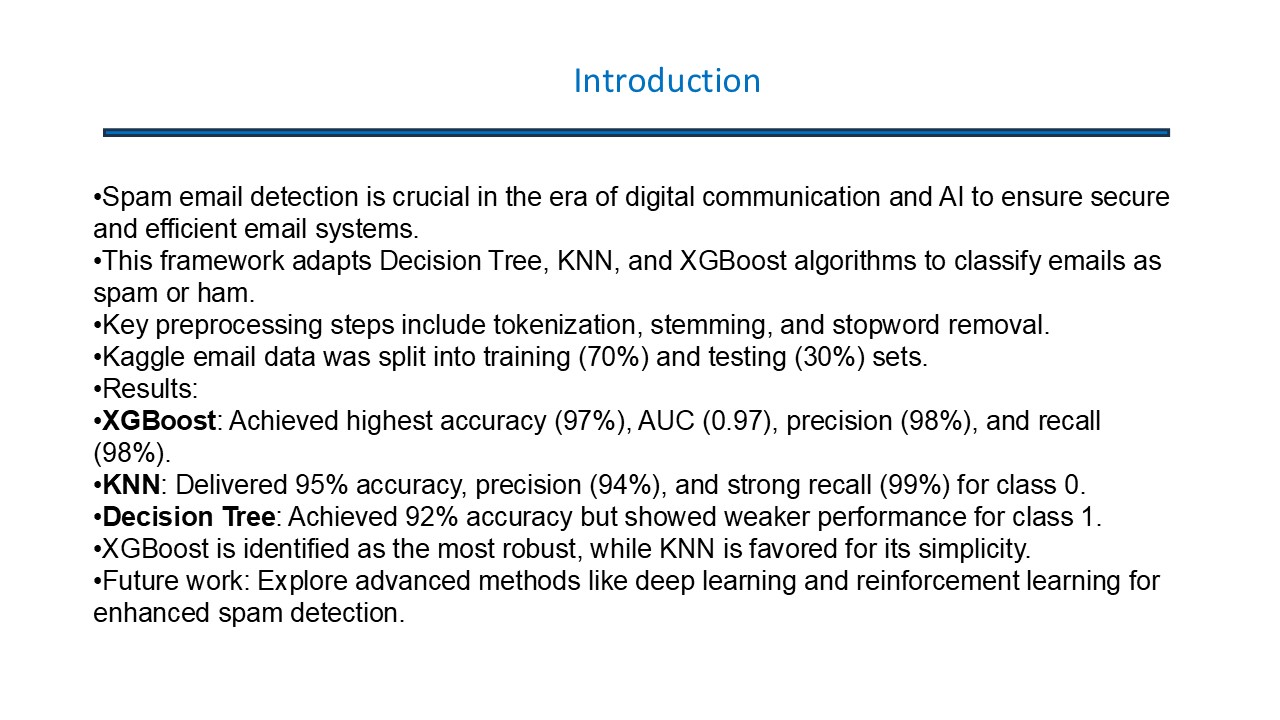
In the age of digital communication and artificial intelligence, spam email detection and classification have become essential tasks to ensure the efficiency and security of email systems. With the increasing volume of email traffic, distinguishing between legitimate emails (ham) and unwanted spam has become more challenging. This research focuses on optimizing machine learning algorithms to enhance spam detection accuracy. We explore the adaptation of Decision Tree, KNN, and XGBoost algorithms, leveraging preprocessing and feature extraction techniques such as tokenization, stemming, and stopword removal. By analyzing email data from Kaggle, split into training and testing sets, we aim to identify the most effective algorithm for spam classification. Our findings demonstrate that well-implemented preprocessing and feature engineering significantly improve model performance, with XGBoost emerging as the most robust algorithm. This study not only contributes to the field of email security but also paves the way for future research into advanced techniques like deep learning and reinforcement learning to further optimize spam detection and address emerging email threats.
|
 IEEE/ICACT20250220 Slide.04
[Big Slide]
[YouTube]