 |
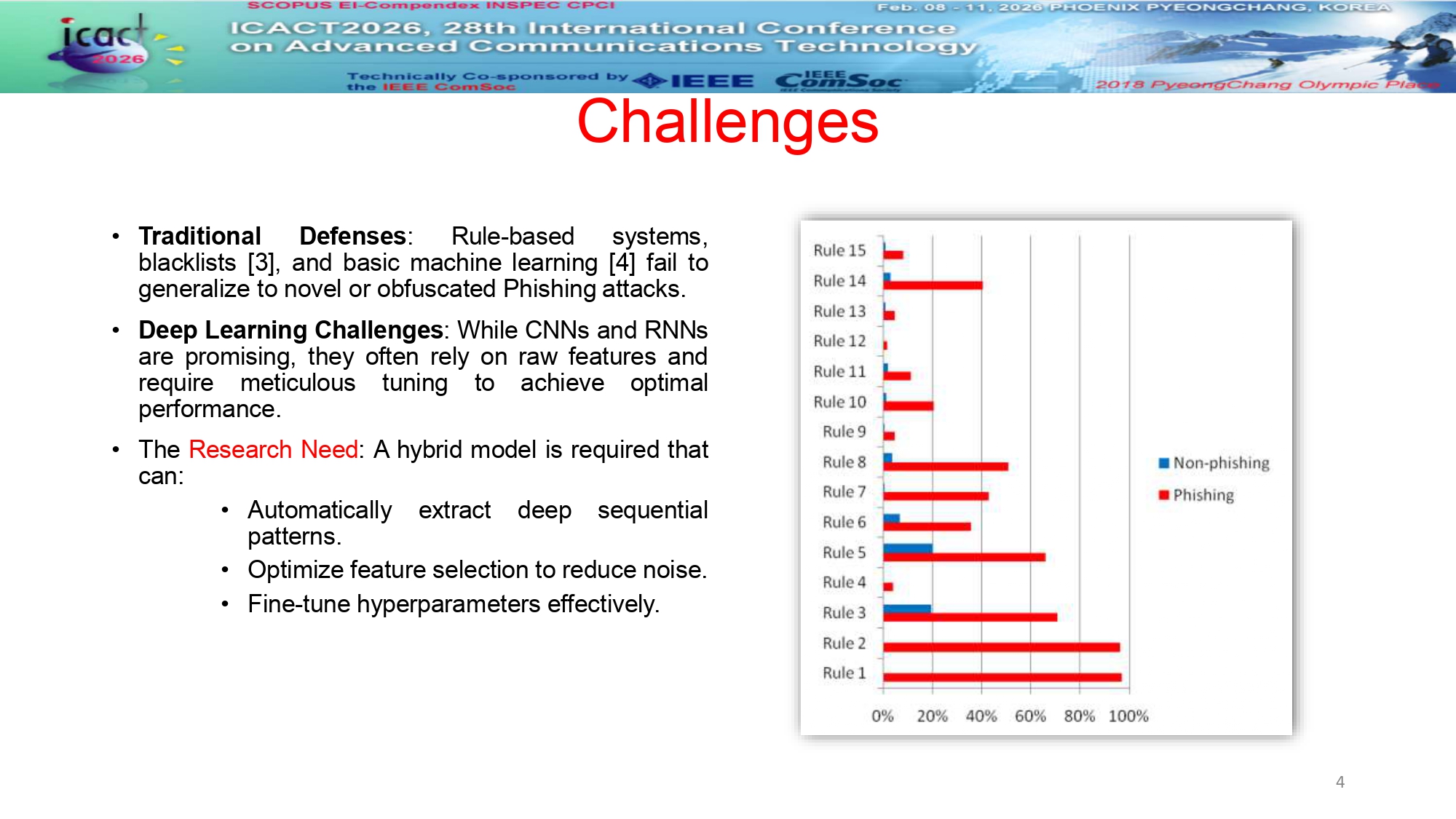
While we understand the global impact of phishing, identifying these threats remains a moving target. Traditional defenses, such as rule-based systems and blacklists, are essentially static. They consistently fail to generalize to novel or obfuscated attacks that attackers generate daily.
Even recent Deep Learning attempts using standard CNNs and RNNs face hurdles. They often rely on raw, noisy features and require meticulous manual tuning to reach high accuracy. This brings us to the core Research Need our paper addresses. We recognized that a truly effective model must be able to do three things: first, automatically extract deep sequential patterns from the URL string itself, second, optimize feature selection to cut through the noise, and third, fine-tune hyperparameters with high precision. Our hybrid approach was designed specifically to meet these three challenges head-on. |
 IEEE/ICACT20260103 Slide.04
[Big Slide]
[YouTube]