 |
Let me start with the background and motivation.
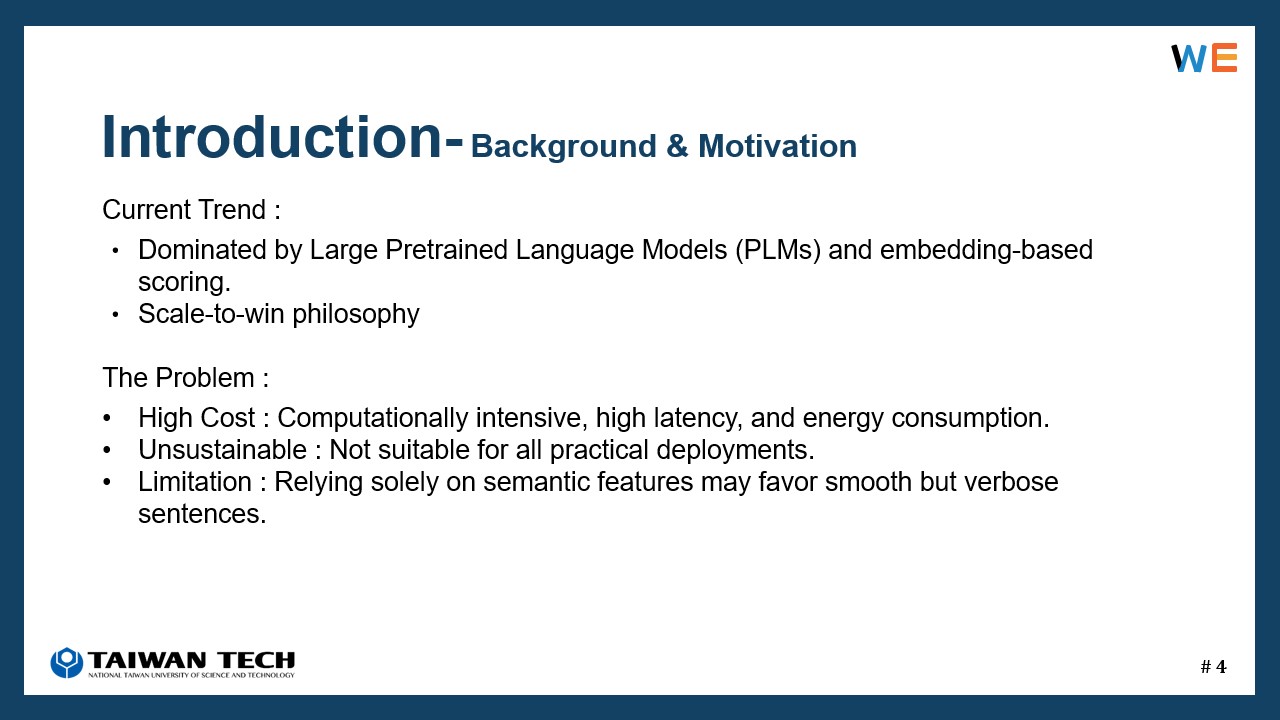
Right now, most extractive summarization methods are based on large pretrained language models or embedding-based scoring.
These models work very well, but in most cases, better performance means larger models.
Larger models usually require more computation, they are slower, and they consume more energy.
Because of that, they are not always a good fit for real-world or resource-limited settings.
Another thing we noticed is that when we rely only on semantic embeddings, the summaries can be fluent, but sometimes they become too long and lose the structure of a good summary.
So we started to ask a simple question: do we really need very large models
to get a good extractive summary? |
 IEEE/ICACT20260145 Slide.04
[Big Slide]