 |
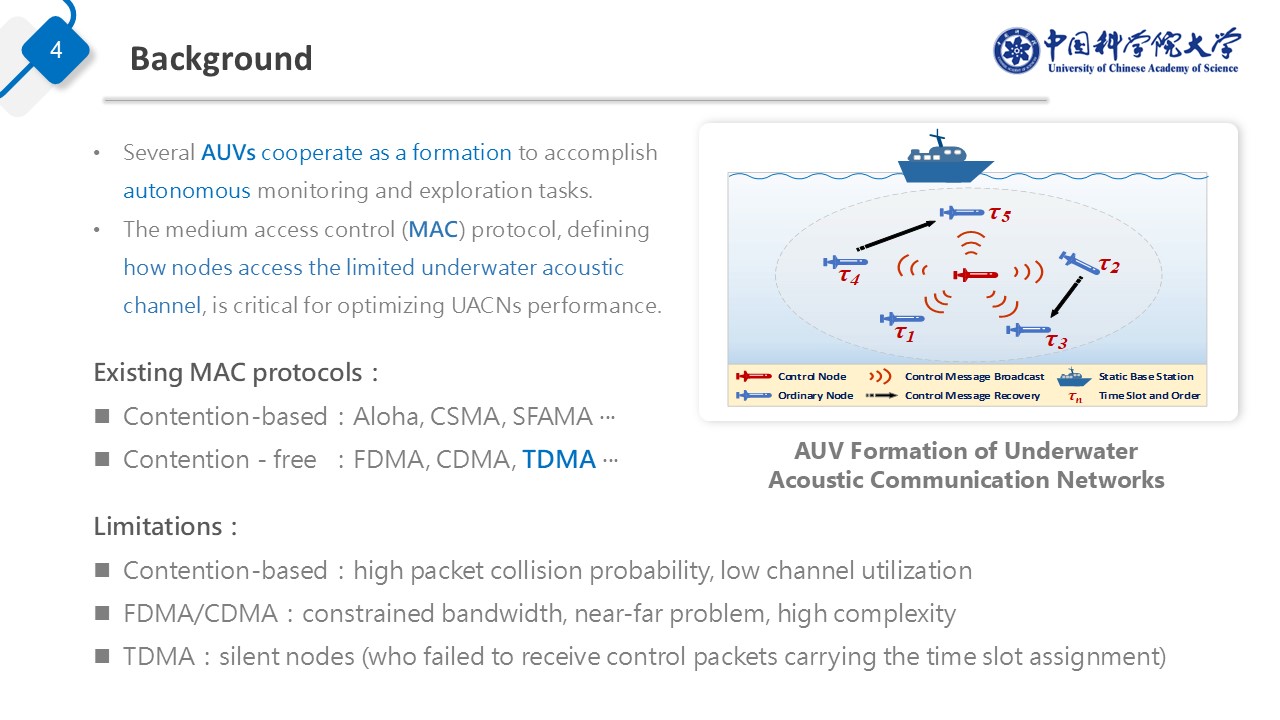
In recent years, rapid advances in AUV technology have greatly expanded their applications in ocean exploration, environmental monitoring, and resource inspection. To improve data collection efficiency and expand exploration range, multiple AUVs often cooperate as a formation, making reliable and timely information exchange essential. This places strict requirements on the underlying underwater acoustic communication networks. Among all network layers, the MAC protocol plays a critical role in determining how nodes access the limited acoustic channel and directly affects network performance. Existing underwater MAC protocols can be broadly classified into contention-based and contention-free protocols. However, contention-based protocols suffer from high collision probability, and low channel utilization, while FDMA and CDMA are limited by bandwidth constraints, the near-far problem, and high complexity. As a result, TDMA is widely adopted in underwater acoustic networks due to its simplicity and inherent collision avoidance characteristics. However, TDMA still suffers from the silent node problem caused by unsuccessful reception of control packets. |
 IEEE/ICACT20260317 Slide.04
[Big Slide]
[YouTube]