 |
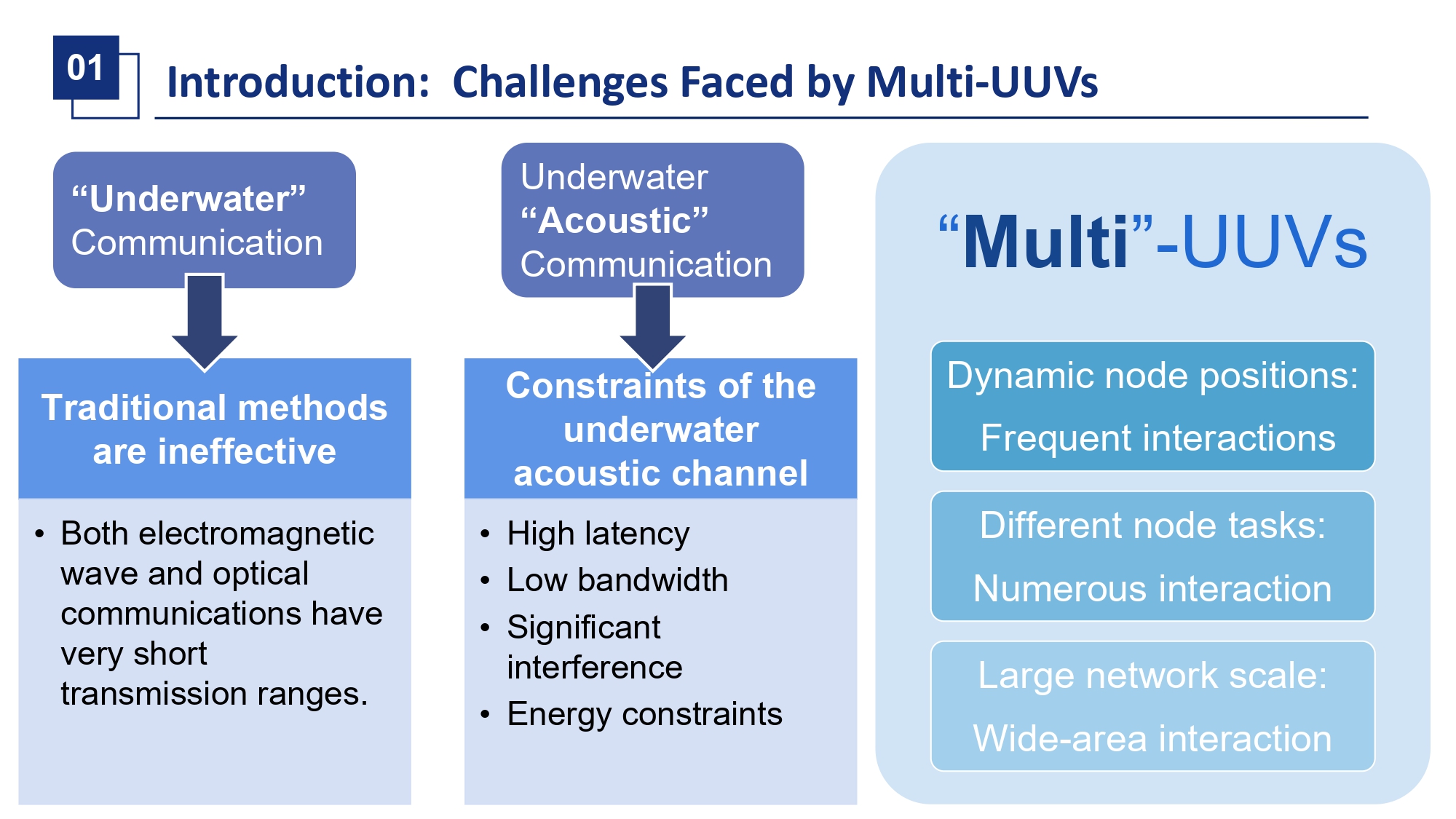
Building a communication network for multi-UUV swarms is exceptionally challenging, primarily due to three layers of difficulty.
First, the underwater medium itself is restrictive. Unlike terrestrial networks, radio waves attenuate rapidly in water, leaving acoustic waves as the only viable communication medium.
Second, the underwater acoustic channel is inherently problematic. It is characterized by slow propagation speed, high latency, low bandwidth, and asymmetry. This results in communication links that are naturally unstable and of low quality.
Third, the characteristics of the UUV swarm further complicate the situation. The vehicles are typically battery-powered and energy-constrained. Moreover, they exhibit high and varied mobility patterns while performing tasks, and their movements can be further disturbed by ocean currents. This leads to highly dynamic and unpredictable network topologies.
In summary, we are dealing with a communication medium that is poor, nodes that are resource-limited, and a network topology that is constantly in flux. |
 IEEE/ICACT20260340 Slide.04
[Big Slide]
[YouTube]