 |
On this slide, I want to explain why we even need ICN and why the NRS-based design matters.
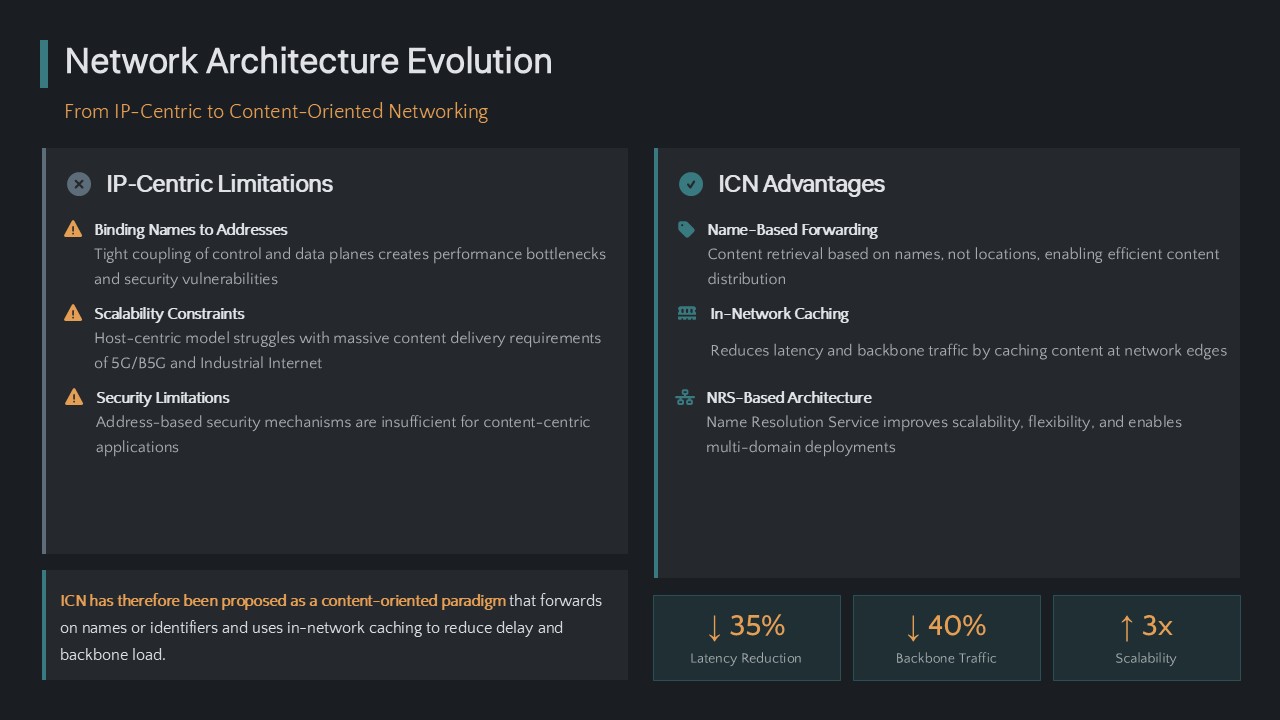
In traditional IP networking, the model binds names to addresses, and the control and data planes are tightly coupled. This creates scalability and security limitations, especially when content volume and mobility keep increasing.
ICN shifts the focus: instead of where is the server, we ask what is the content, and the network can cache data along the path. This naturally reduces repeated backbone traffic and improves user-perceived latency because popular content can be served closer to the edge.
Now, ICN designs split into two families.
One is pure name-based routing, like NDN or CCN, where routers maintain PIT, FIB, and CS tables and do per-hop name-prefix forwarding.
The other is NRS-based ICN, where a separate name resolution system maps identifiers to forwarding hints or locators, and the control plane can distribute forwarding state in a more protocol-agnostic way.
This separation improves scalability, but it also means the security bottlenecks move to the resolution–control loop. |
 IEEE/ICACT20260343 Slide.04
[Big Slide]
[YouTube]