 |
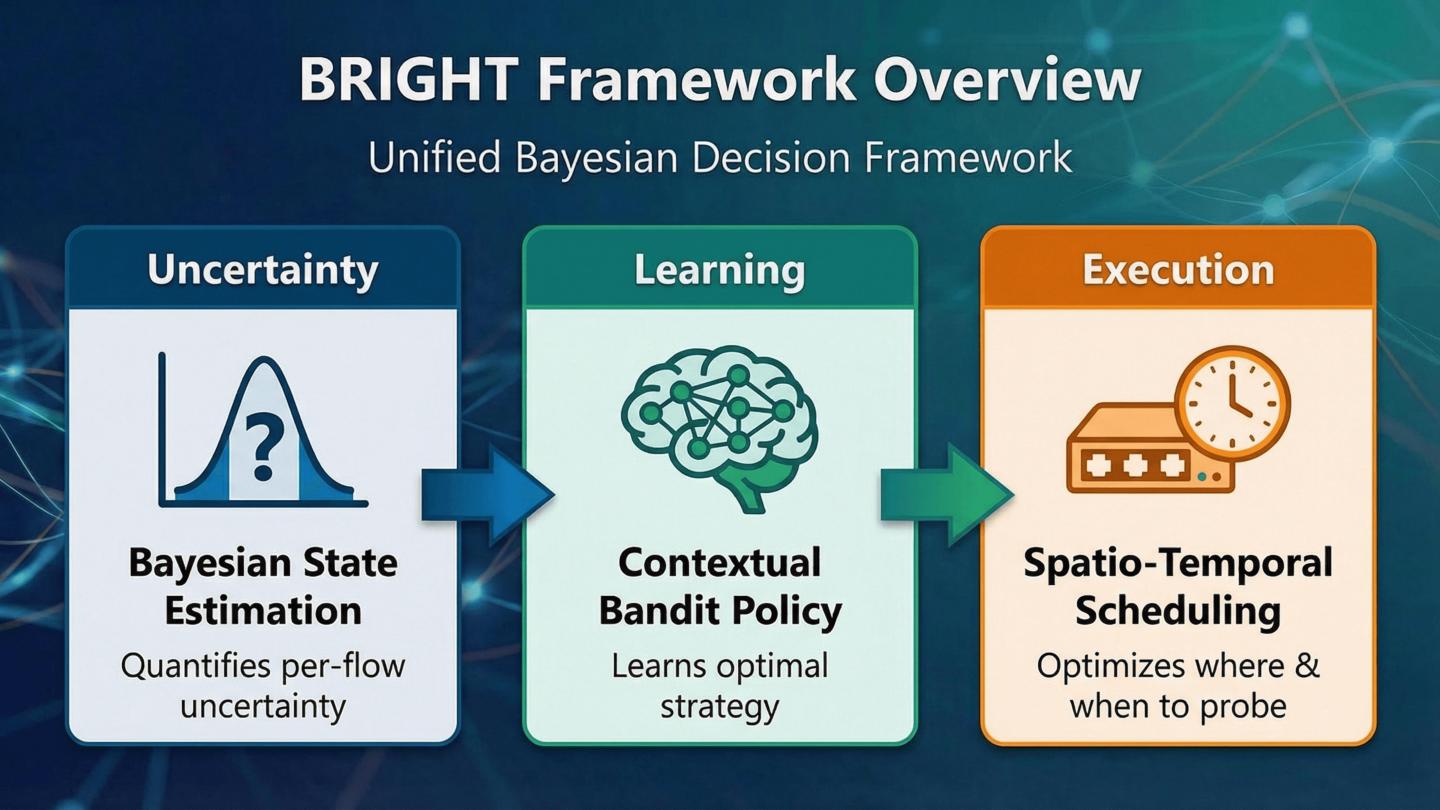
BRIGHT solves the limitations of static monitoring by modeling it as a sequential decision process that continuously learns and adapts. Our framework is built on the novel integration of three core technologies. First, we use Bayesian state estimation to maintain a lightweight Gaussian posterior for every active flow. This is crucial because it allows us to quantify uncertainty, distinguishing between flows we know well and flows that require more attention. Second, we employ a contextual bandit approach for policy learning. This system automatically selects the optimal monitoring template—a strategy that specifies the total budget and which flows to prioritize—based on the current network state. Finally, a spatio-temporal scheduler maps that selected template into concrete probing decisions, minimizing the cost of each query and balancing the load across switches. This three-part architecture ensures that BRIGHT is both uncertainty-aware and highly adaptive, allowing us to focus our limited resources where they matter most. Now, lets look at the mathematical foundation that underpins this framework.
|
 IEEE/ICACT20260358 Slide.04
[Big Slide]
[YouTube]