 |
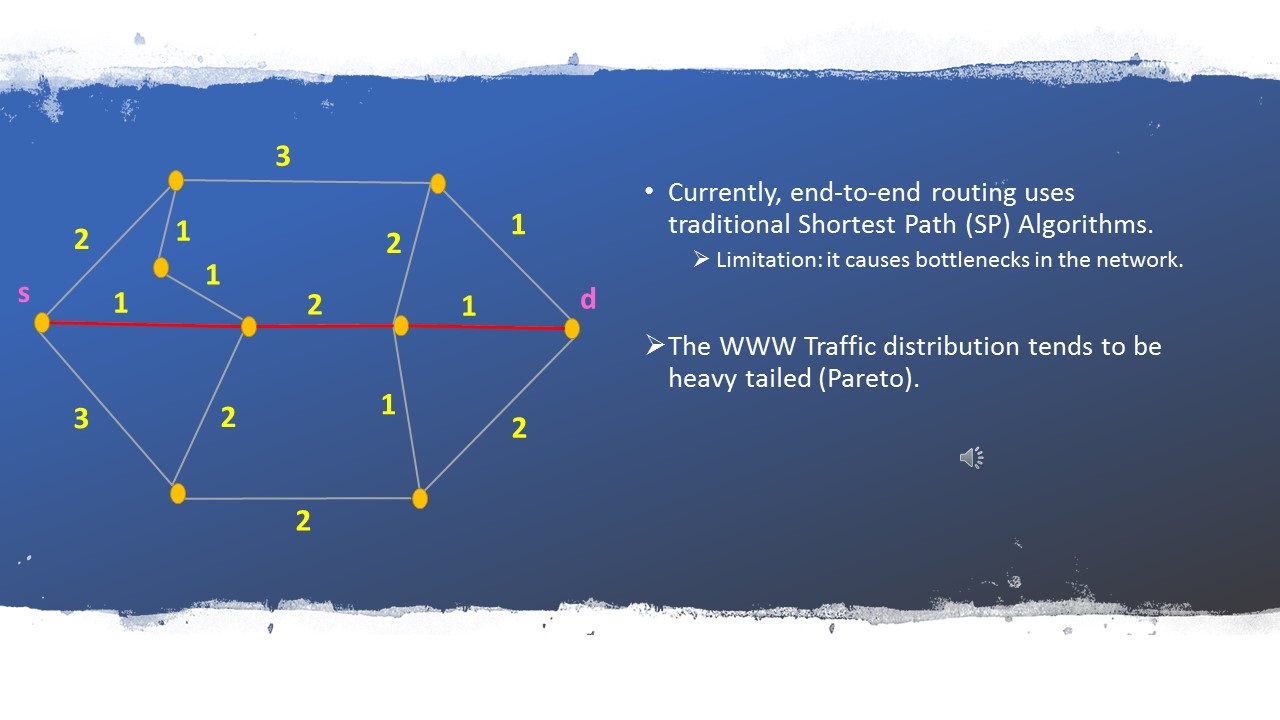
Shortest Path algorithms are most widely used in end-to-end routing algorithms, however, they do not consider explicitly bottlenecks when routing which results in poor performance in high load networks. The shortest path based algorithms consider the shortest distance path or the minimum hops path. Bottlenecks in networks occur when a high traffic flow demands to be routed over a set of edges where the number of flows are exceeding the edge capacity which leads to congestion at the edges. The Shortest Path finds the shortest path available and sends the traffic which most likely will meet in a specific path segment which causes the bottleneck problem. Clearly, the routing algorithm that will resolve or at least minimize the occurrence of bottleneck problem has to consider congestion explicitly within its algorithm.
Routing on the World Wide Web has self similarity traffic which tends to be heavy tailed distribution file size and that self similarity effects the network performance. One common heavy tailed distribution is the Pareto distribution which we adopt for our flow size distribution.
|
 IEEE/ICACT20210213 Slide.05
[Big Slide]
[YouTube]