 |
We collected network flows from a model factory that uses 5G networks. Subsequently, the collected data were replayed on the 5G testbed described above.
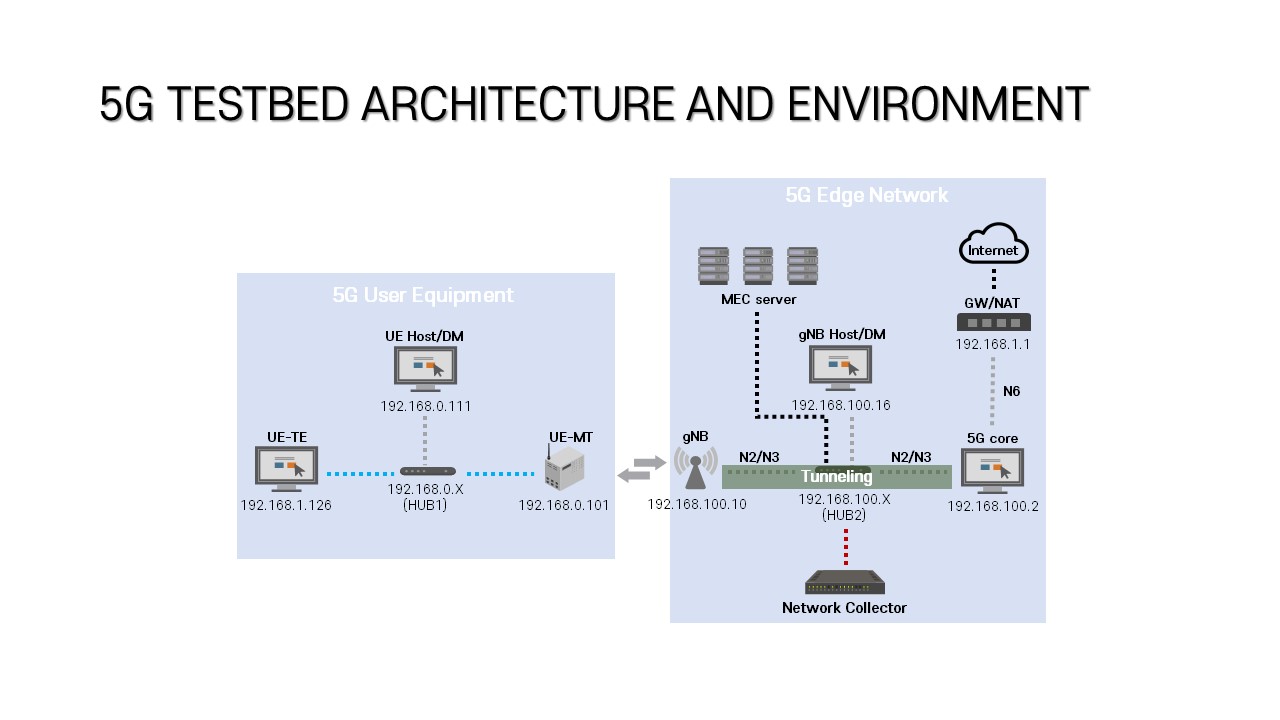
Based on the 5G network structure, the implemented 5G testbed comprised a UE–MT for wireless communication, a UE as a user terminal, a UE–DM for verifying the UE¡¯s status, a gNB as a base station, and a gNB–DM for verifying the gNB¡¯s status. Fig. 2 shows the components for our implemented testbed.
The UE–MT and gNB are radio sections that are connected to the AMF through the N2 interface, and a data transmission device is connected to the UPF through the N3 interface. In the 5G testbed, SCTP and UDP protocols are primarily used in the gNB and 5GC sections, and data passing through the section is tunneled to the UDP with a 4-byte header.
The backhaul network comprises network elements and communication channels between the gNB as the base station and 5GC as the core network. In particular, similar to 4G LTE, these channels are encapsulated by a tunneling protocol, which is typically known as GTP. Because of the tunneling mechanism, when the network collector captures the network raw data, the original end-to-end network information is contained to the payload data of the captured data instead of to the IP. Therefore, to be aware of the original network information, the tunneled header must be eliminated, except in some cases. In the case of control plane data similar to SCTP, because they are not designed to be encapsulated, the tunneling header must be maintained.
Hence, we developed a specialized network collector system that can extract the original end-to-end network features to collect network traffic through tunneling in a 5G network. The network collector was positioned between the gNB and 5GC.
|
 IEEE/ICACT20210225 Slide.05
[Big Slide]