 |
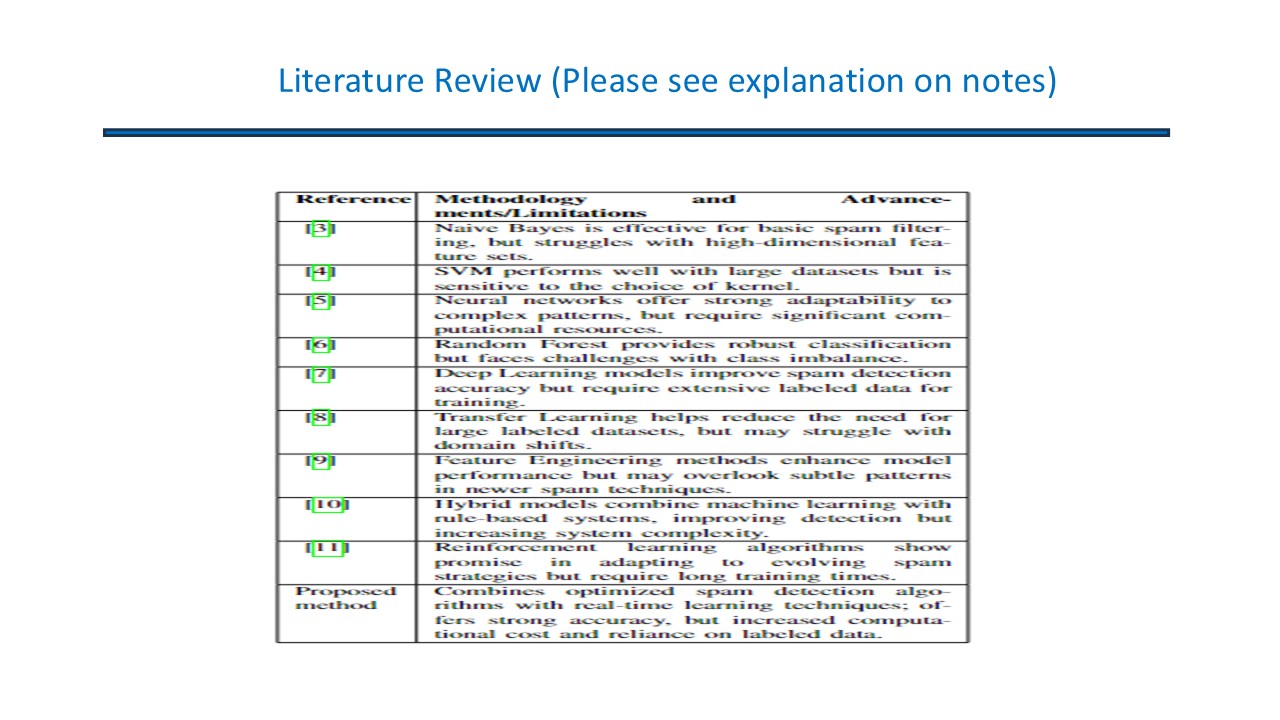
The literature on spam email detection and classification highlights the critical role of machine learning algorithms in enhancing email security. Various studies have explored the effectiveness of different algorithms, including Decision Tree, KNN, and XGBoost, in identifying spam emails. Preprocessing and feature extraction techniques, such as tokenization, stemming, and stopword removal, are commonly employed to improve model performance1
. Research indicates that XGBoost often outperforms other models in terms of accuracy and robustness, achieving high precision and recall rates2
. However, challenges remain due to the dynamic nature of spammer strategies and the dataset shift problem, which can degrade model performance over time2
. Future research directions include the application of advanced techniques like deep learning and reinforcement learning to further optimize spam detection and address emerging email threats3
.
|
 IEEE/ICACT20250220 Slide.05
[Big Slide]
[YouTube]