 |
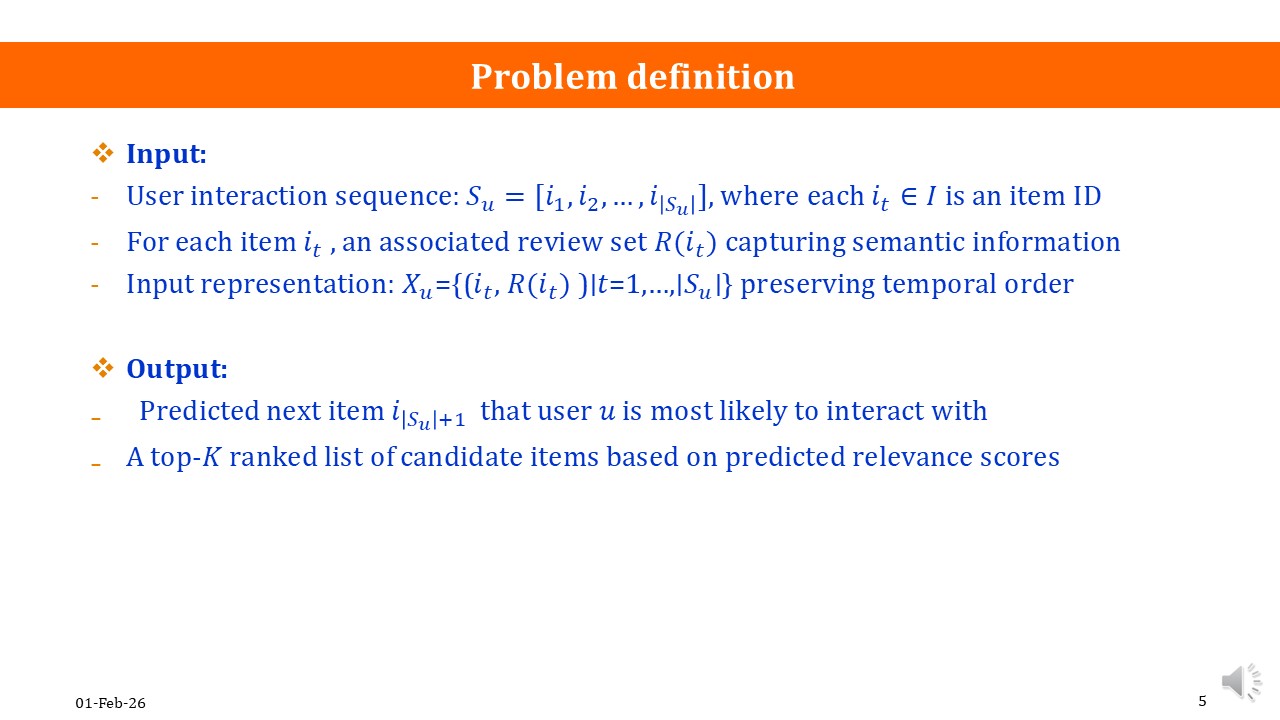
In this work, we consider a sequential recommendation setting with a user set U and an item set III.�Each user u¡ôU is associated with a chronological interaction sequence Su=[i1,i2,¡¦,i∣Su∣], where each iti_tit denotes an item that the user has interacted with, such as viewing, purchasing, or reviewing. This sequence captures the temporal evolution of user preferences.
Unlike ID-only approaches, our input not only includes item identifiers but also semantic information from textual reviews. For each item it, we associate a review set R(it), which contains user-generated reviews describing item characteristics and user experiences.
Therefore, the input for user uuu is represented as an ordered sequence of item–review pairs, preserving temporal dependencies. The goal is to predict the next item i∣Su∣+1 that the user is most likely to interact with, and to rank candidate items to produce a top-K recommendation list based on predicted relevance scores.
|
 IEEE/ICACT20260275 Slide.05
[Big Slide]