 |
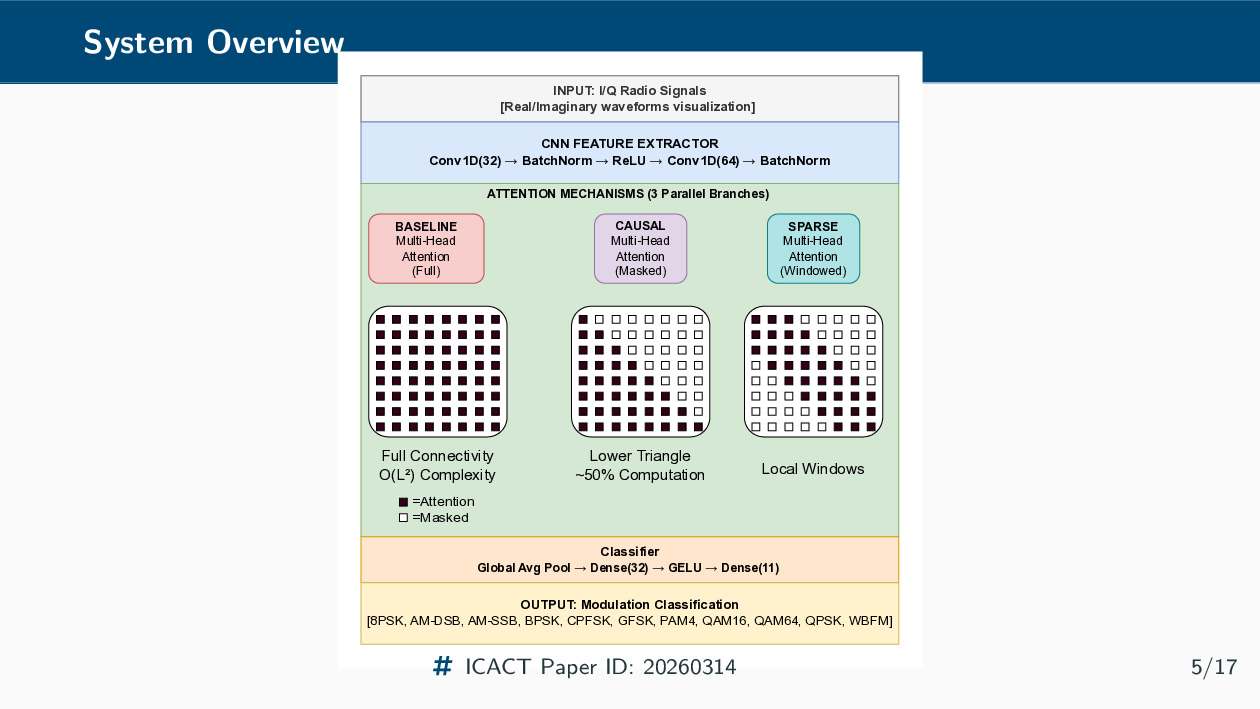
This slide illustrates the overall system overview of the proposed approach.
The input consists of complex-valued in-phase and quadrature, or I/Q, samples, which are converted into a two-channel real-valued representation.
A convolutional neural network is used to extract local spatial features from the input signal.
These features are then processed by Transformer blocks with different attention mechanisms to capture temporal dependencies.
Finally, a global pooling layer and a classifier are used to predict the modulation class. |
 IEEE/ICACT20260314 Slide.05
[Big Slide]
[YouTube]