 |
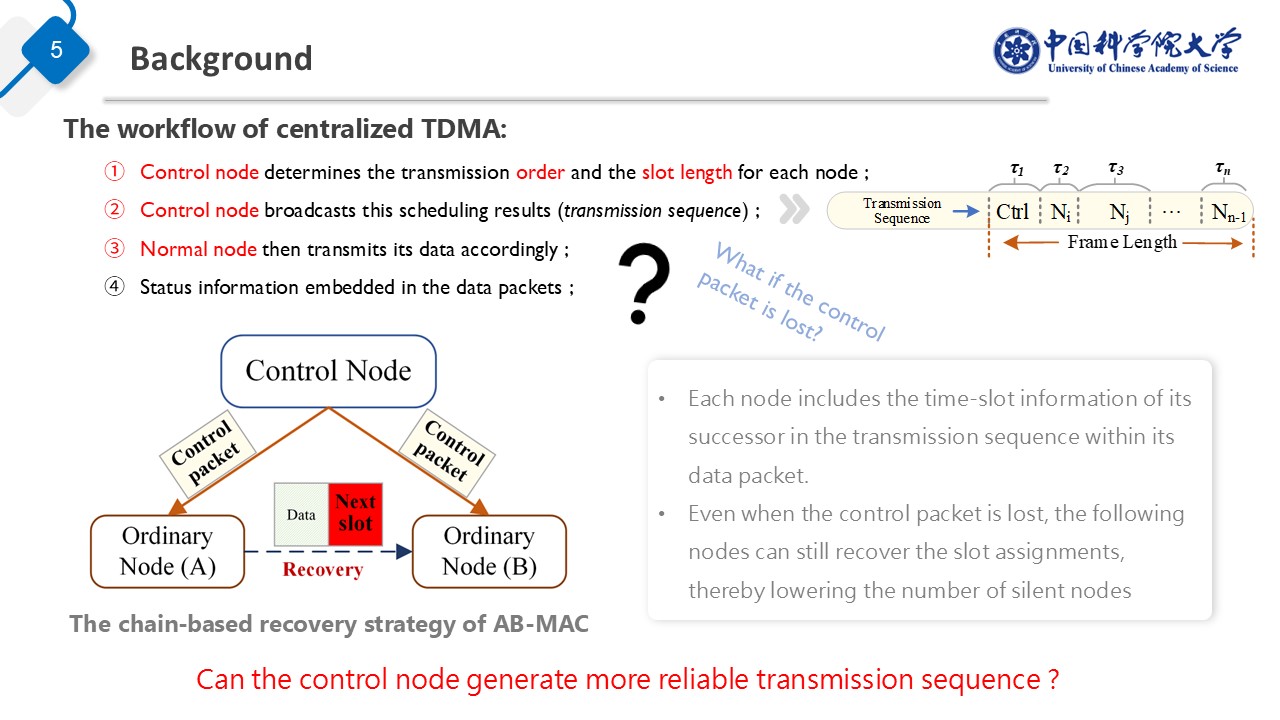
The workflow of centralized TDMA MAC protocols consist of several steps: First, Control node determines the transmission order and the slot length for each node ; Second, Control node broadcasts this scheduling results (called transmission sequence) ; Third, Normal node then transmits its data accordingly with status information embedded in the data packets.
If the control packet is lost, normal nodes cannot obtain their slot assignments and therefore remain silent to avoid additional collisions. This is known as the silent node problem.
To address this issue, AB-MAC proposes a chain-based recovery strategy. Each node embeds the time-slot information of its successor in the transmission sequence into its data packet. In this way, even if the control packet is lost, subsequent nodes can still recover their slot assignments, which significantly reduces the number of silent nodes.
Based on this recovery strategy, we raise the following question: can the control node generate a more reliable transmission sequence? |
 IEEE/ICACT20260317 Slide.05
[Big Slide]
[YouTube]