 |
Now lets look at the challenges in current RNIC cache designs. The first challenge is Head of Line Blocking.
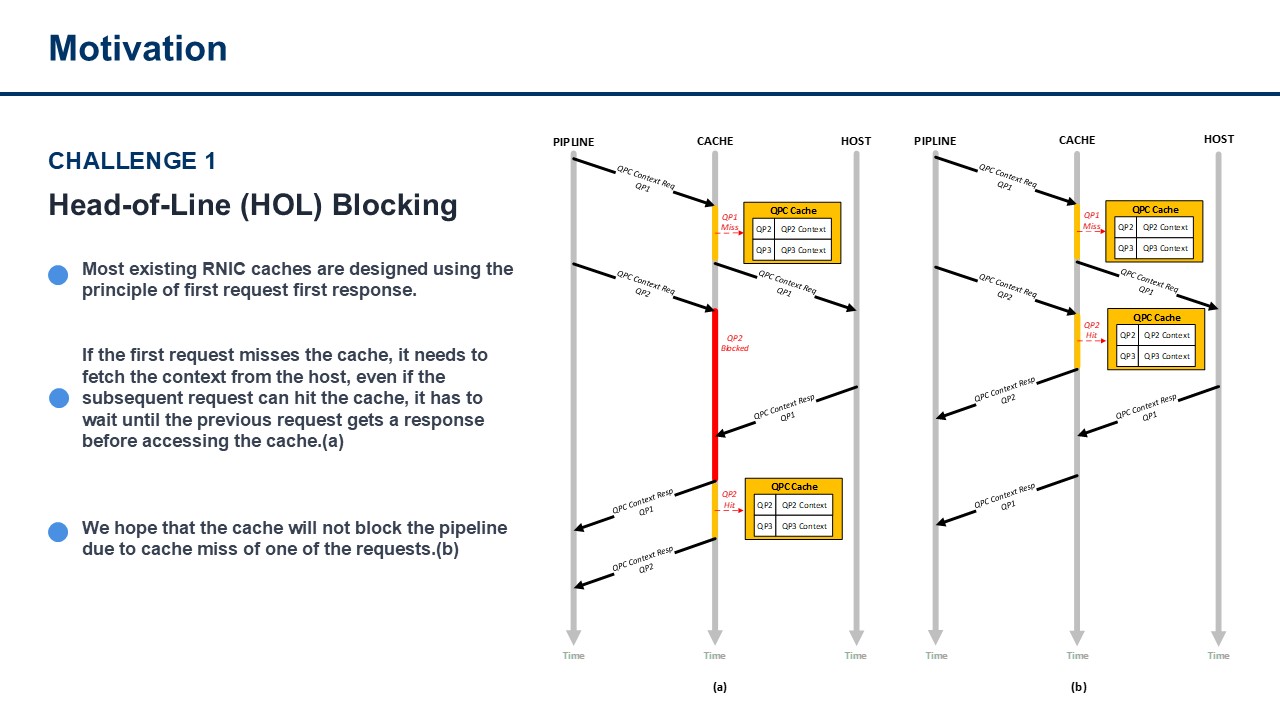
Most existing RNIC caches follow a simple principle: first request, first response. But this creates a problem.
As illustrated in figure a, when the first request from QP1 misses the cache, it has to fetch the context from the host memory. During this time, even if the subsequent request, QP2, could hit the cache, it still has to wait until QP1 gets its response. This is classic head of line blocking, and it significantly hurts performance.
What we want instead is shown in figure b, the cache should not block the entire pipeline just because one request has a cache miss. Ideally, QP2 should be able to proceed immediately if it hits the cache, without waiting for QP1. |
 IEEE/ICACT20260320 Slide.05
[Big Slide]
[YouTube]