 |
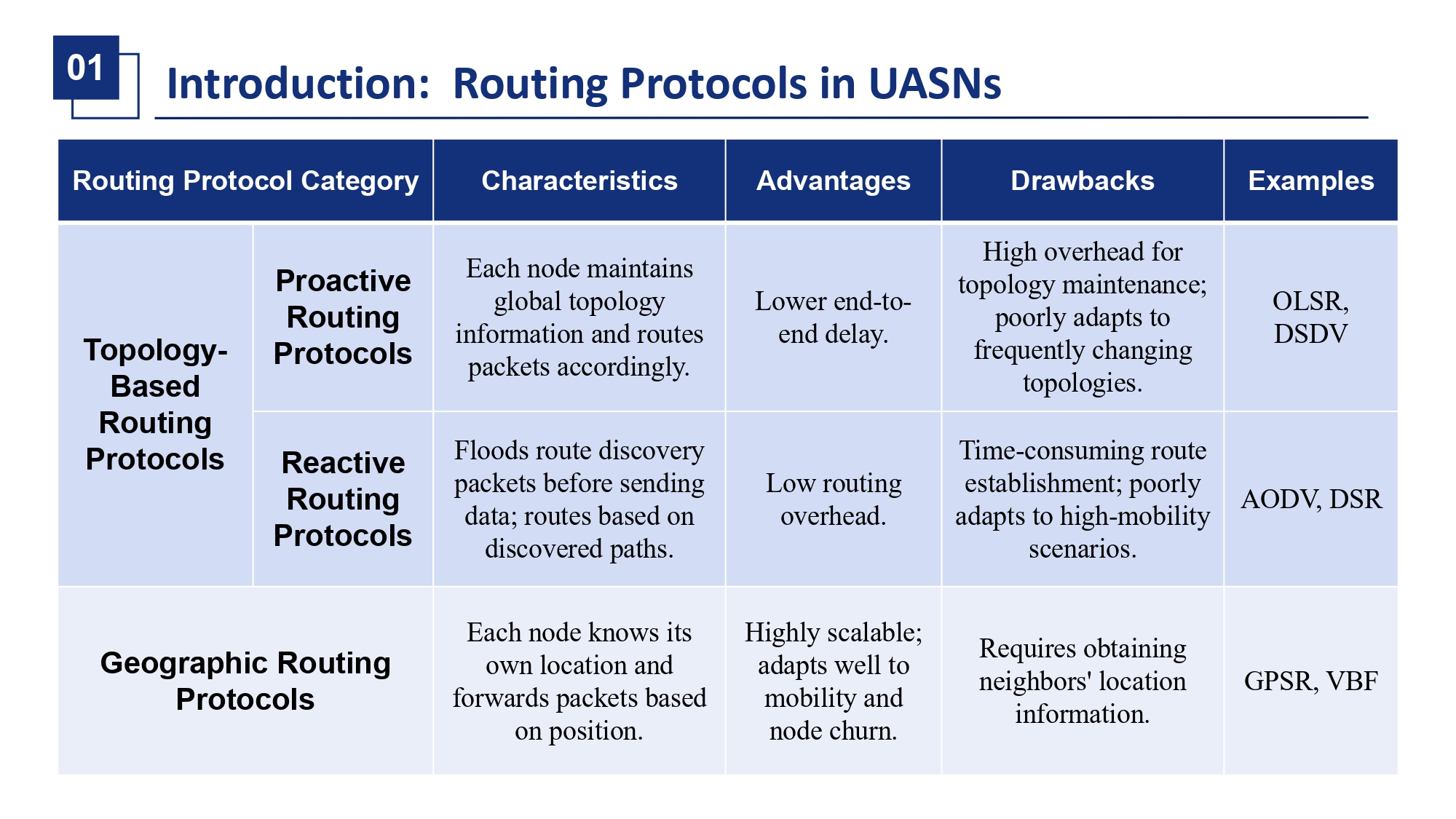
Then, lets briefly review existing routing approaches for underwater networks. They are generally classified into three types. Proactive protocols, like OLSR, maintain global routing tables, incurring excessive control overhead in mobile scenarios. Reactive protocols, like AODV, use flooding for route discovery, introducing long delays unsuitable for the slow acoustic medium. Geographic protocols, like GPSR, use location information for forwarding. They have high beaconing overhead to track moving neighbors and overly simplistic next-hop selection, often leading to poor link quality in mobile environments. Clearly, none of these are fully adequate for multi-UUV swarms. |
 IEEE/ICACT20260340 Slide.05
[Big Slide]
[YouTube]