 |
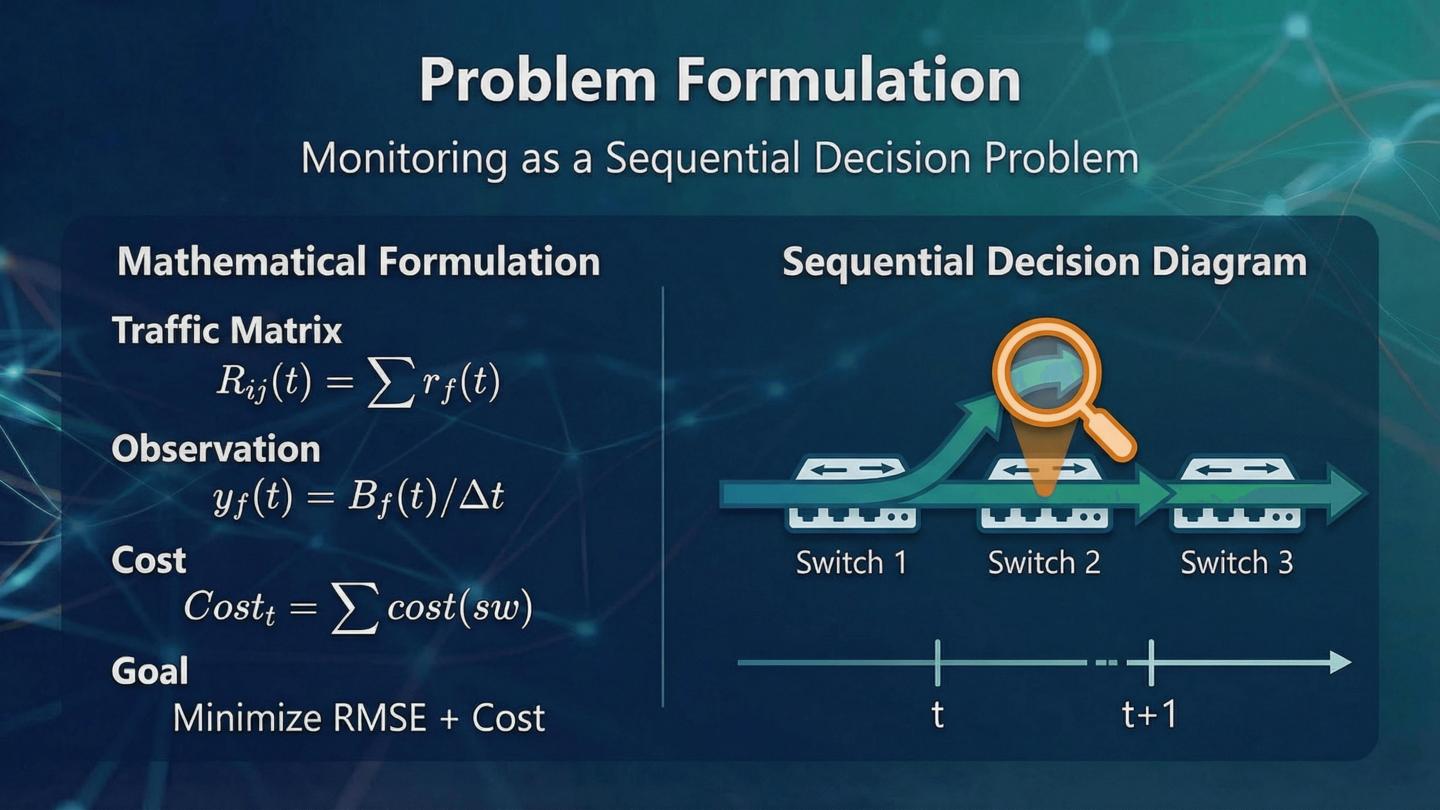
To formalize the problem, we model traffic monitoring as a sequential decision-making process under uncertainty. Our goal is to minimize the combined cost of measurement error and monitoring overhead over time. This is a complex optimization problem because the state of the network—the true traffic matrix—is only partially observable. We define the state of the system by the current traffic matrix and the accumulated uncertainty in our flow estimates. The action space is the selection of a monitoring template, which dictates the probing intensity. The reward function is designed to balance three competing objectives: maximizing accuracy, minimizing control-plane overhead, and ensuring fair load balancing across switches. Specifically, the reward is the negative sum of the traffic matrix RMSE, the monitoring cost, and the variance in switch load. By framing the problem this way, we can apply the powerful tools of reinforcement learning to find the optimal policy. This mathematical framework allows BRIGHT to learn the trade-offs between accuracy and efficiency automatically. Next, well examine the detailed architecture that implements this formulation.
|
 IEEE/ICACT20260358 Slide.05
[Big Slide]
[YouTube]