 |
So, channel tracking's primary goal is to update the channel parameters instead of estimating each time and decrease the overall number of transmitted pilot signals. For this, one needs to consider the dynamics of the channel and how it varies with time. A couple of questions arise here. First, how can we measure the channel variation? Second, how to decide to select channel estimation or update channel parameters?
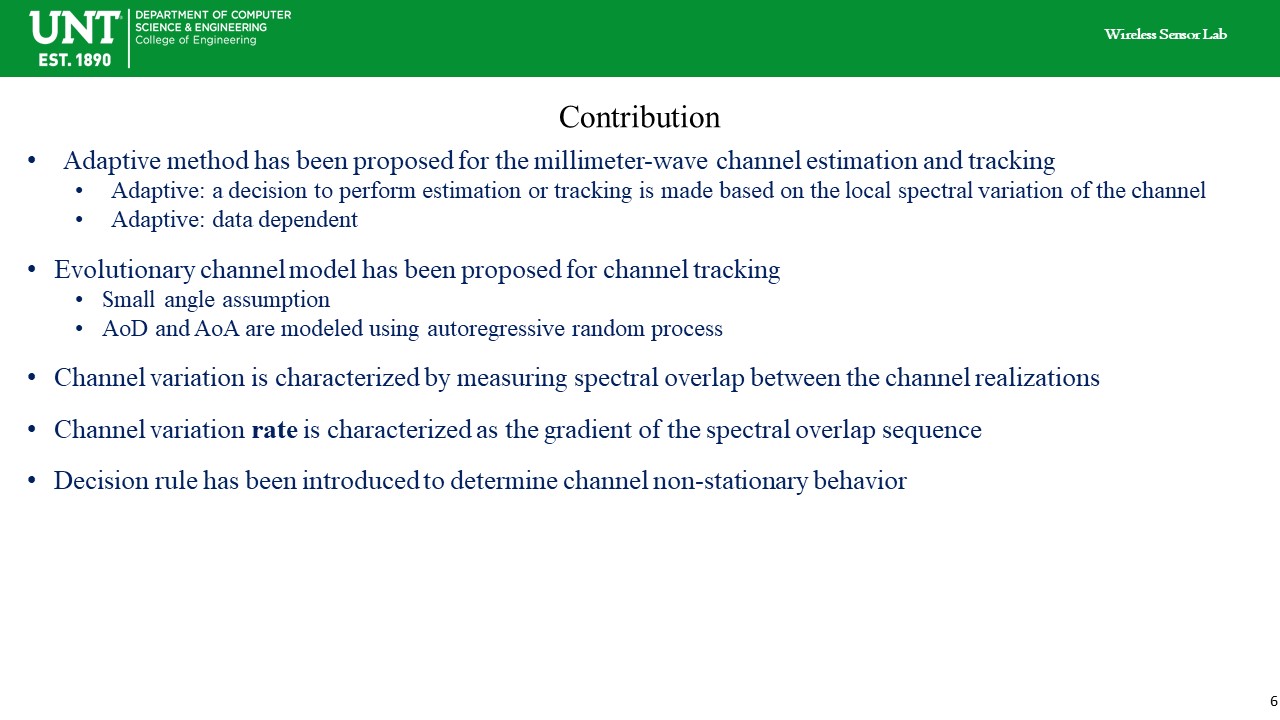
To answer the first question, we need to understand that the channel dynamics is characterized by the spectral overlap between the channel realizations. Moreover, the rate that the channel dynamics varies with time is measured statistically as the local spread of the spectral overlap between channel realizations.
We purpose to select channel estimation or channel tracking adaptively by characterizing the local dynamics of the channel. For this, we model the channel dynamics using its spectral properties. Then, locally, we decide if the channel experiences significant variation or not. If there is a significant channel variation, the channel parameters have to be estimated. Otherwise, they can be updated. To update the parameters, we purpose the evolutionary channel model using a small-angle assumption; that is, we assume the AoD and AoA are varying smoothly with time.
In the following slides, we discuss how to measure the spectral overlap between the channels and how to decide if the channel parameters have to be estimated or updated. |
 IEEE/ICACT20210129 Slide.06
[Big Slide]