 |
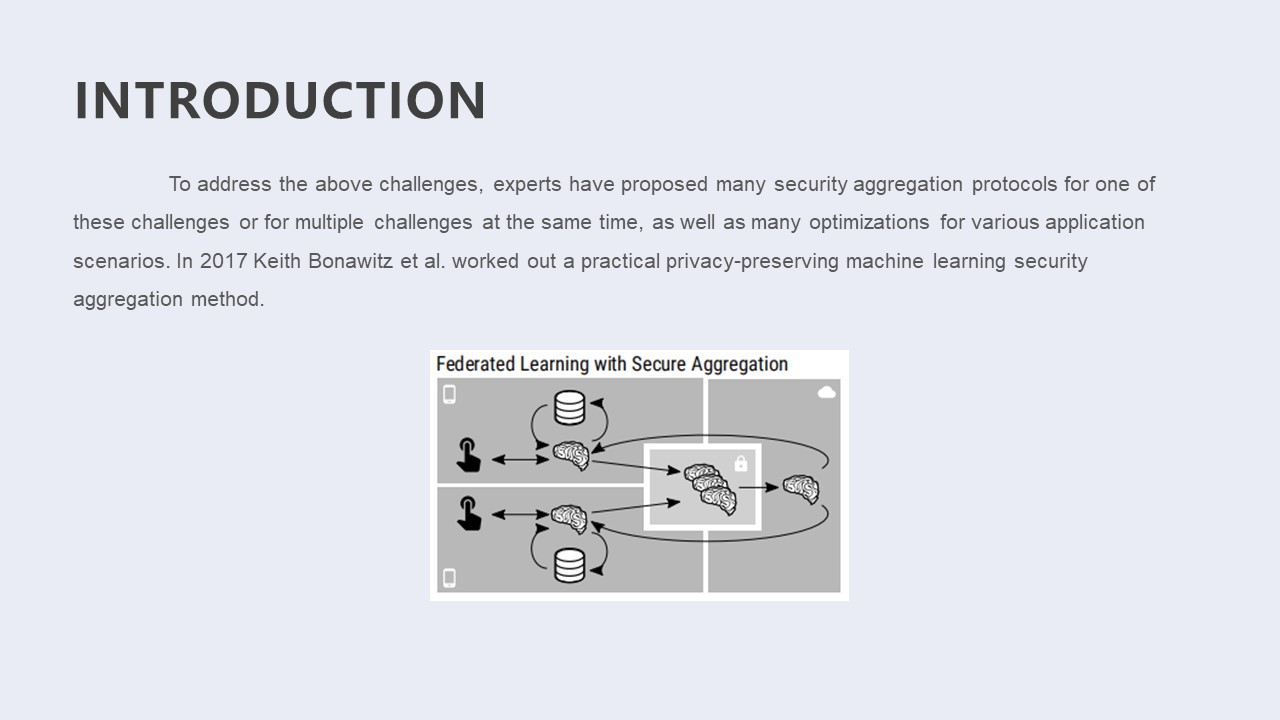
To address the above challenges, experts have proposed many security aggregation protocols for one of these challenges or for multiple challenges at the same time, as well as many optimizations for various application scenarios. In 2017 Keith Bonawitz et al. worked out a practical privacy-preserving machine learning security aggregation method which proposes a secret sharing and its innovative double-mask structure based on a secure aggregation protocol for FL that not only protects against semi-honest and malicious attackers but also is robust to users' mid-way dropout. After this study was published, many scholars joined the study of secure aggregation for FL and proposed many innovative secure aggregation protocols, although their performance makes them unsuitable for most practical applications. However, they have created a very active research area in the design and implementation of secure aggregation protocols. As a result of these efforts, the performance and usability of secure aggregation protocols have steadily improved. The following diagram expresses the basic idea of secure aggregation. Based on federated learning, the user's gradients are aggregated by an aggregator and then sent to the server to ensure the privacy of each individual user's gradient. |
 IEEE/ICACT20220347 Slide.06
[Big Slide]
[YouTube]