 |
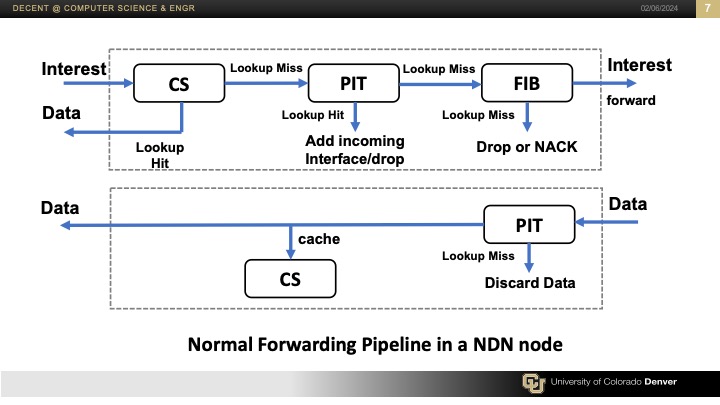
To demonstrate these issues of broadcasting in NDN, first let take a look at how it works. NDN broadcast-based forwarding strategy follows the general NDN architecture. An NDN consumer sends an Interest with a name when it wants to retrieve data. Upon receiving the Interest, a node will look at its Content Store (CS) and replies with data on a name match. Otherwise, the Interest is passed to
the Pending Interest Table (PIT). If there is an entry with the same name in the PIT, the Interest is discarded, and the entry is updated to include the new request. If no entry in the PIT matches the Interest¡¯s name, a new entry is created with the incoming interface and passes the Interest to its Forwarding Information Base (FIB). Next, the node performs the longest common prefix match to existing FIB prefix entries. With the general NDN architecture, the node forwards the Interest through the associated interface(s) to the next hop node(s) if a match is found. If a match is not found, it either drops the Interest or sends a NACK (negative acknowledgment) back. This will inform the other nodes that a route through this node is unavailable. |
 IEEE/ICACT20240480 Slide.06
[Big Slide]
[YouTube]