 |
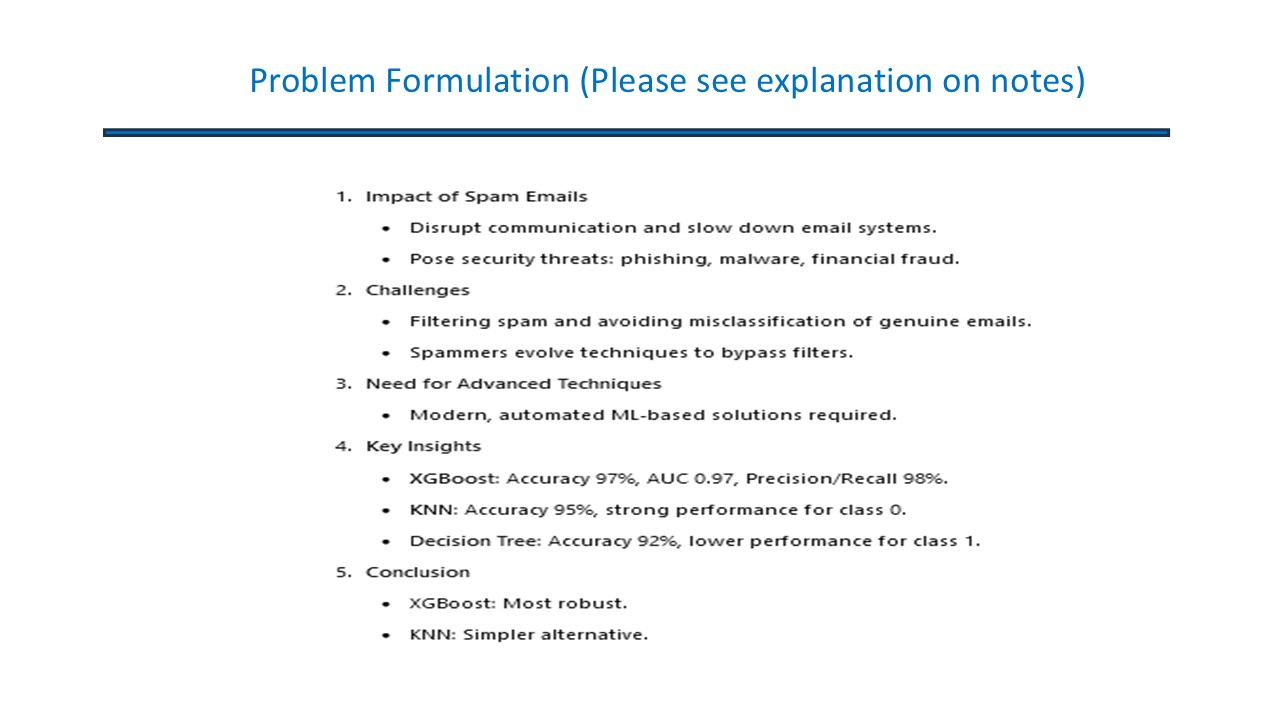
The primary challenge in spam email detection is accurately distinguishing between legitimate emails (ham) and unwanted spam, given the evolving tactics of spammers. Current machine learning models, while effective, often struggle with maintaining high accuracy and robustness due to the dynamic nature of spam content and the presence of noisy data. This research aims to address these issues by formulating a problem where the goal is to optimize spam detection algorithms to enhance their performance. Specifically, we focus on evaluating the effectiveness of Decision Tree, KNN, and XGBoost algorithms in classifying emails as spam or ham. The problem is further complicated by the need for efficient preprocessing and feature extraction techniques, such as tokenization, stemming, and stopword removal, to improve model accuracy. By leveraging a dataset from Kaggle, split into training and testing sets, we aim to identify the most robust algorithm that can adapt to changing spam patterns and provide reliable spam detection.
|
 IEEE/ICACT20250220 Slide.06
[Big Slide]
[YouTube]