 |
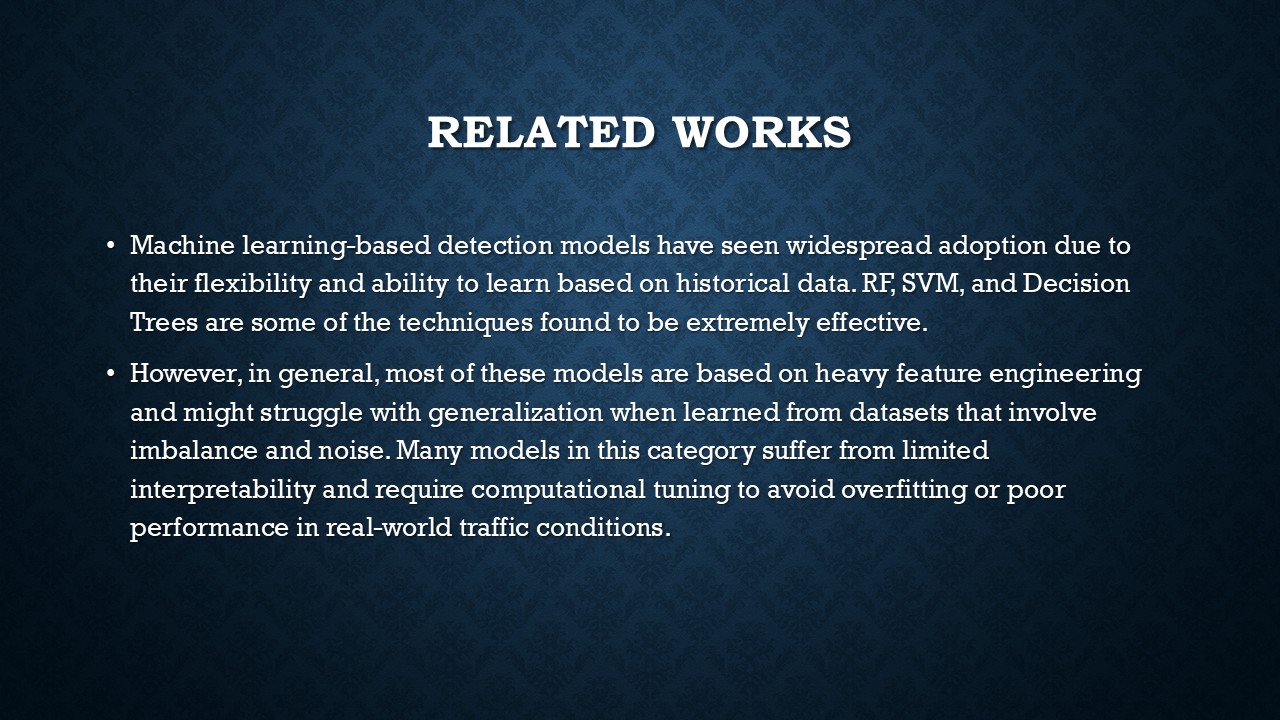
In recent years, machine learning-based phishing detection models have gained significant attention due to their flexibility and ability to learn patterns from historical data. Commonly used techniques include Random Forest, Support Vector Machine, and Decision Tree models, which have shown strong performance in identifying phishing activities.
However, despite their effectiveness, many of these models rely heavily on extensive feature engineering, which can be time-consuming and dataset-dependent. Additionally, these models may face challenges in generalizing when trained on datasets that contain imbalance or noise. Another limitation is the lack of interpretability in some machine learning models, and they often require careful parameter tuning to prevent overfitting and to maintain good performance when deployed in real-world network traffic environments. |
 IEEE/ICACT20260061 Slide.06
[Big Slide]