 |
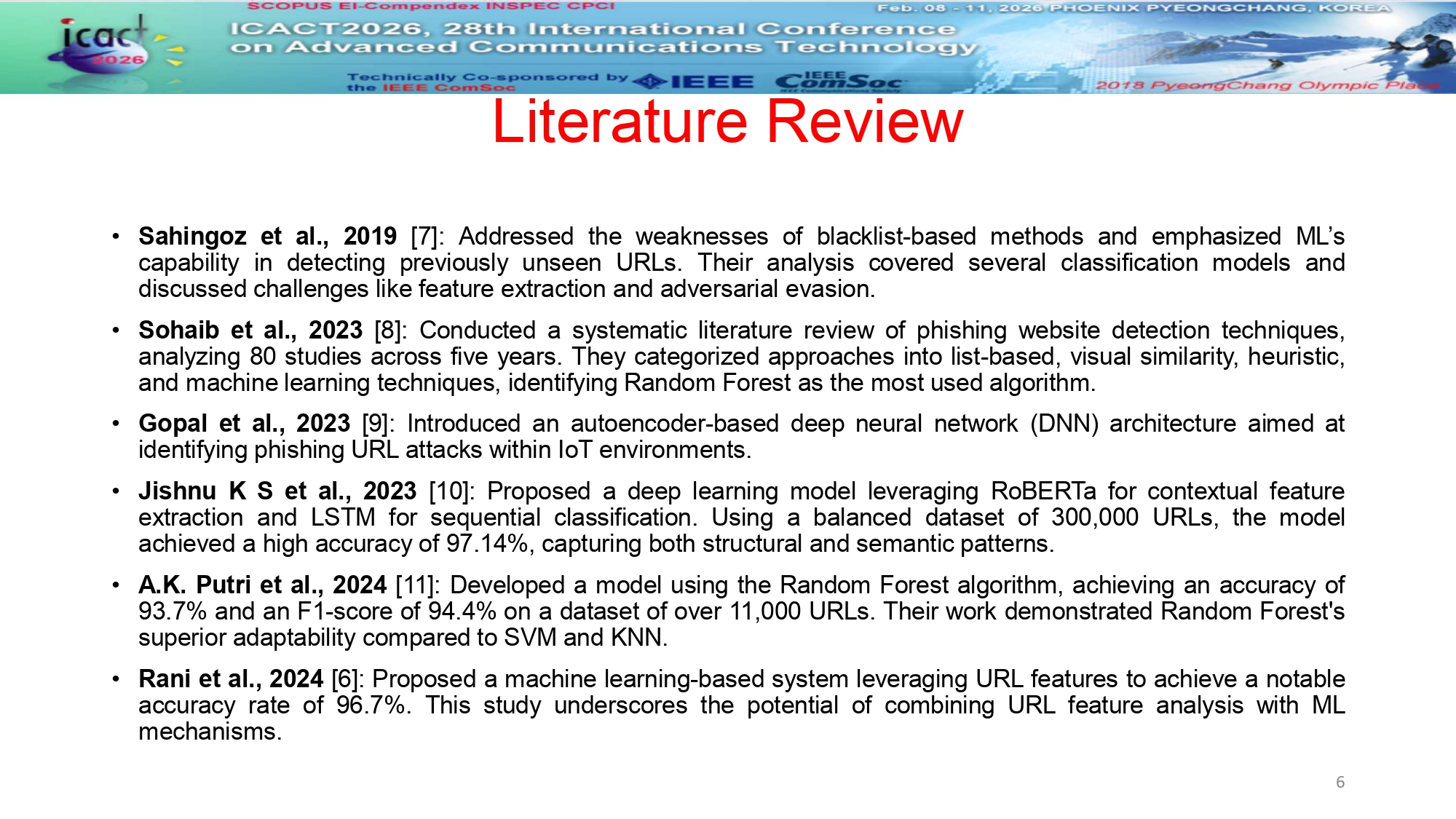
To place our research in context, we reviewed the evolving landscape of phishing detection. Early work, such as by Sahingoz et al., highlighted the move away from static blacklists toward machine learnings ability to detect unseen URLs.
More recently, Sohaib et al. identified Random Forest as a dominant traditional algorithm, while Putri et al. achieved solid results with it on a dataset similar in size to ours.
We also looked at deep learning advancements. Gopal et al. introduced autoencoders for IoT environments, and Jishnu K S et al. leveraged transformer-based RoBERTa and LSTM to capture complex semantic patterns, reaching an accuracy of 97.14%.
While these studies are impressive, they often rely on fixed architectures. Our work builds on this foundation by introducing hEVOSWO, a hybrid optimizer that doesnt just use deep learning, but dynamically fine-tunes it to achieve even higher precision and robustness. |
 IEEE/ICACT20260103 Slide.06
[Big Slide]
[YouTube]