 |
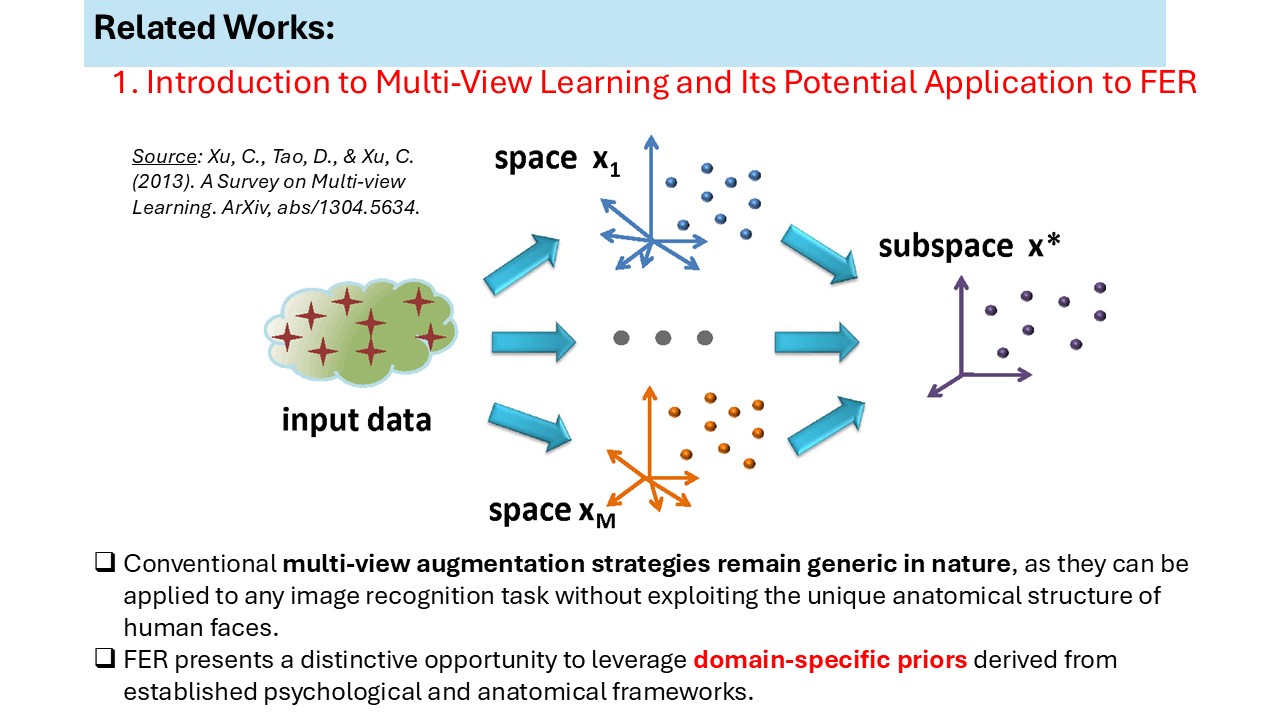
Recent studies have increasingly adopted multi-view learning paradigms. In this approach, multiple augmented versions of the same input image—obtained through transformations including horizontal flipping, random cropping, affine warping, or color space modifications—are treated as distinct yet semantically consistent views. Joint learning across these complementary views enhances model robustness and encourages invariance to nuisance factors. However, conventional multi-view augmentation strategies remain generic in nature, as they can be applied to any image recognition task without exploiting the unique anatomical structure of human faces.
In contrast, FER presents a distinctive opportunity to leverage domain-specific priors derived from established psychological and anatomical frameworks. Specifically, Action Units (AUs), as formally defined by the Facial Action Coding System (FACS) developed by Ekman and Friesen in 1978, describe localized regions of facial muscle activity that exhibit strong correlations with emotional expressions. Prior researches in the field of computer vision, such as Martinez et al. in 2019 and Belharbi et al. in 2024, have also established comprehensive mappings between facial expressions and their corresponding action units.
|
 IEEE/ICACT20260151 Slide.06
[Big Slide]