 |
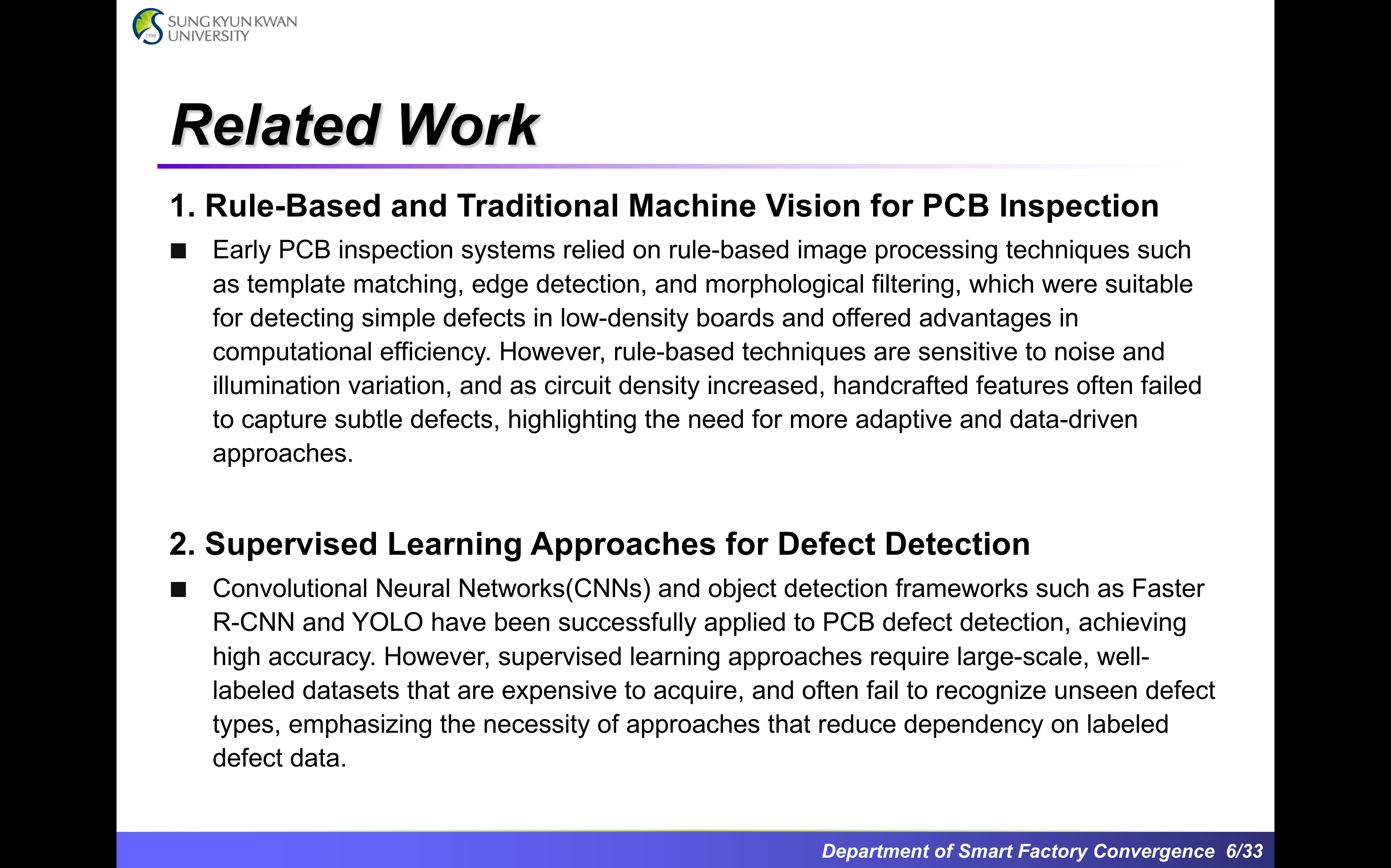
First, regarding rule-based and traditional machine vision for PCB inspection: early systems relied on techniques such as template matching, edge detection, and morphological filtering. These methods offered computational efficiency and interpretability and were suitable for detecting simple defects in low-density boards.
However, rule-based techniques are inherently sensitive to noise and illumination variation. As circuit density increased, handcrafted features often failed to capture subtle and irregular defects, resulting in frequent false positives and reduced robustness.
Second, supervised learning approaches using Convolutional Neural Networks and object detection frameworks such as Faster R-CNN and YOLO have been successfully applied to PCB defect detection, achieving high accuracy with sufficient annotated datasets. However, they face significant challenges in industrial adoption due to their reliance on large-scale, well-labeled datasets. Moreover, they often fail to recognize unseen or rare defect types, reducing their robustness in dynamic production environments. |
 IEEE/ICACT20260190 Slide.06
[Big Slide]