 |
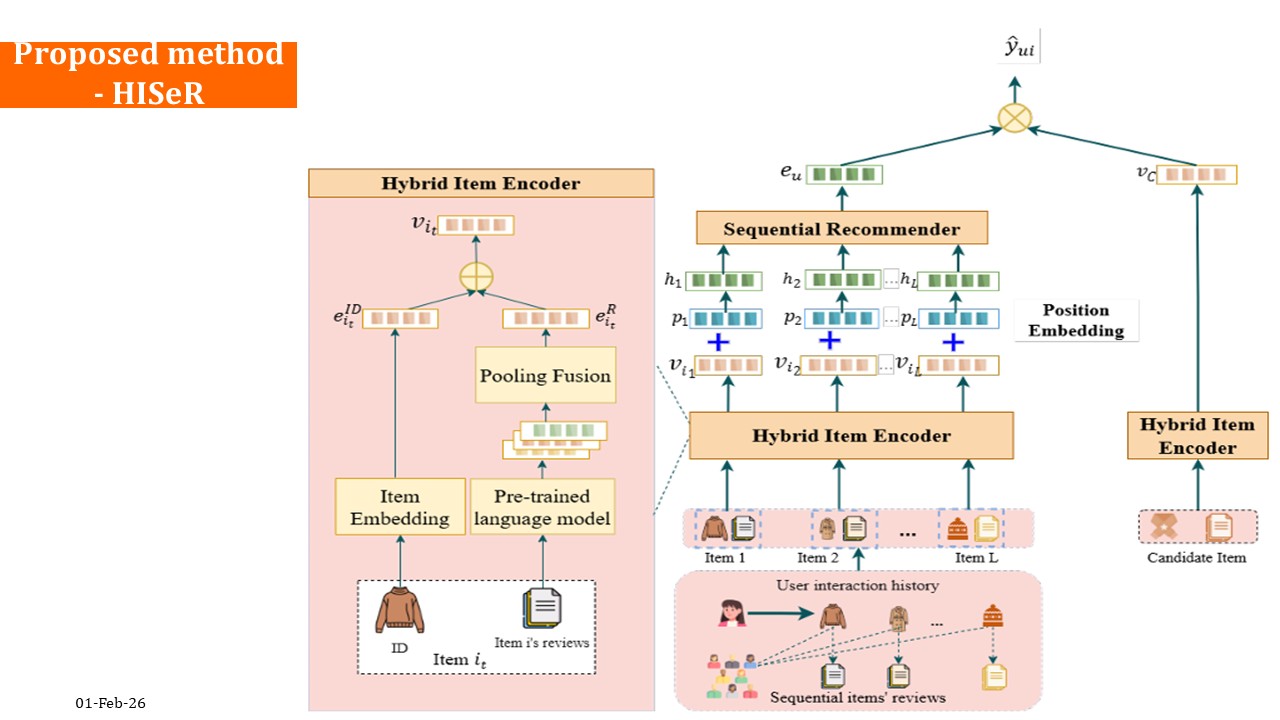
This is the overall architecture of the proposed HiSeR (Hybrid Item Encoding for Transformer-based Sequen tial Recommendation) model. The main objective of HiSeR is to jointly integrate two complementary types of information: behavioral signals from sequential item IDs interactions and semantic signals extracted from textual reviews. By combining these modalities, the model can more accurately capture the temporal evolution of user preferences. Each item in a user¡¯s interaction sequence is first encoded by the Hybrid Item Encoder (HIE), which serves as the core component of HiSeR. The HIE consists of two parallel branches: (1) an ID-based branch, which transforms the item identifier into a dense embedding vector that reflects collaborative behavioral patterns; and (2) a review-based branch, which encodes textual reviews associated with the item using a pre-trained language model to extract semantic representations. The two embeddings are then fused to form a unified hybrid item representation that preserves both collaborative and semantic characteristics. Next, positional embeddings are added to these hybrid item representations to encode the order and temporal relationships among user interactions. The ordered sequence is then fed into a Transformer-based Sequential Encoder, which captures dependencies between items and learns a dynamic user rep representation that reflects the user¡¯s current intent within the interaction context. For each candidate item, HiSeR also applies the same Hybrid Item Encoder to obtain its corresponding representation. The model then computes the similarity between the user representation and each candidate item embedding to estimate the relevance score. Items with the highest scores are returned as recommendations.
|
 IEEE/ICACT20260275 Slide.06
[Big Slide]