 |
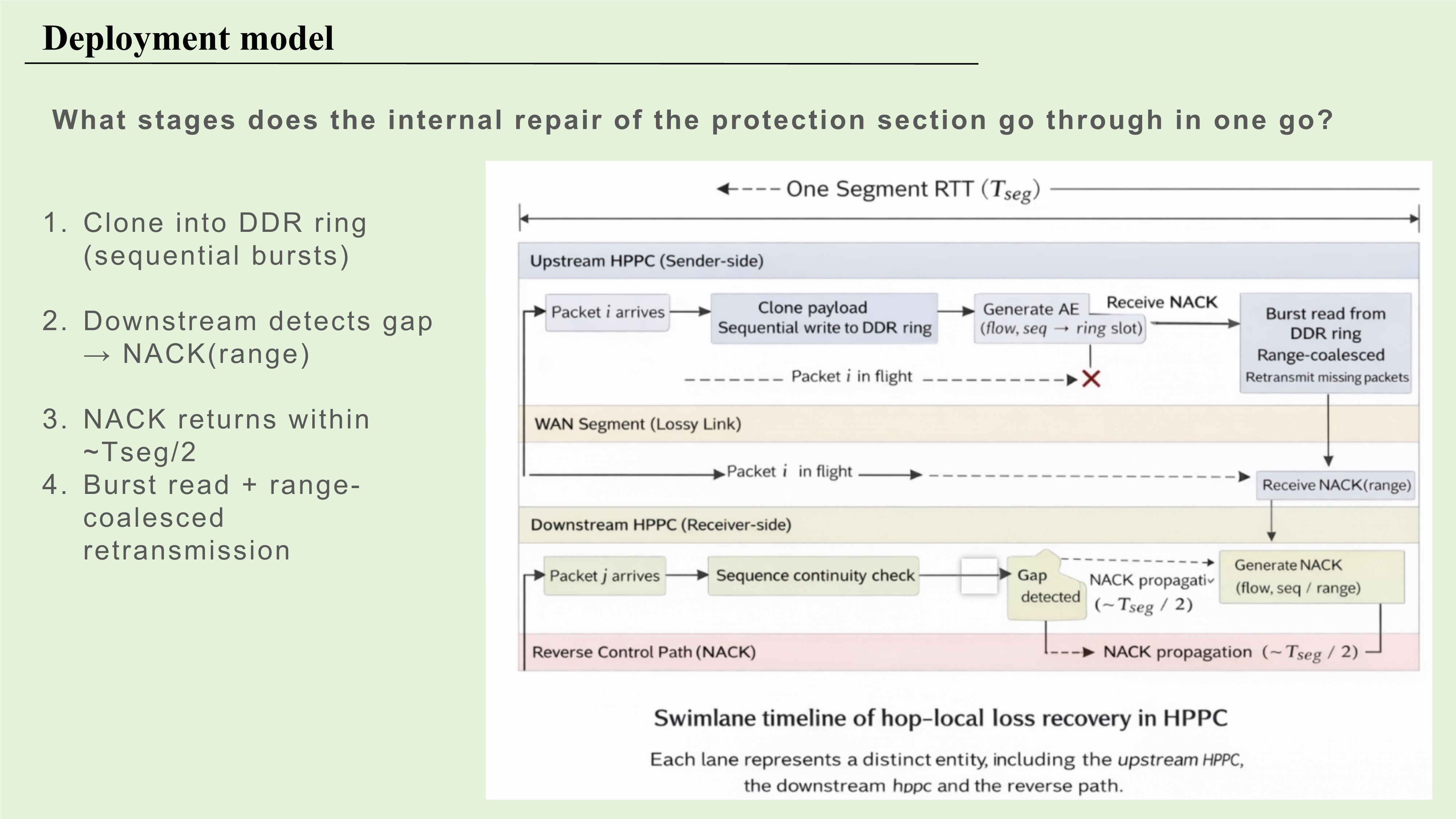
This slide explains how HPPC performs hop-local loss recovery within a single protected segment.
On the left, we summarize the process into four stages, all of which complete within one segment RTT, denoted as 𝑇seg.
First, the upstream HPPC clones packets into the DDR ring.
When a packet arrives at the upstream HPPC node, it is forwarded as usual, while its payload is simultaneously cloned into a DDR-resident circular buffer.
Importantly, this is done using sequential burst writes to preserve DDR row-buffer locality and minimize access overhead.
Second, the downstream HPPC detects a sequence gap.
At the other end of the protected segment, the downstream HPPC checks packet sequence continuity on a per-flow basis.
If a later packet arrives while an earlier sequence number is missing, a gap is detected locally.
Third, a NACK is generated and propagated back.
Upon detecting the gap, the downstream HPPC generates a NACK, typically covering a range of missing packets rather than a single sequence number.
This NACK travels back to the upstream node along the reverse control path, with a propagation delay of approximately half a segment RTT, or Tseg/2.
Finally, the upstream HPPC performs burst read and retransmission.
Once the NACK is received, the upstream HPPC uses its compact index to locate the corresponding packets in the DDR ring,
reads them out sequentially in bursts, and retransmits the missing packets in a range-coalesced manner.
Overall, this timeline shows that HPPC can detect and repair losses entirely within one segment RTT,
avoiding slow end-to-end congestion control reactions and enabling high goodput over long-BDP wide-area networks. |
 IEEE/ICACT20260323 Slide.06
[Big Slide]
[YouTube]