 |
Limitations of Existing Methods
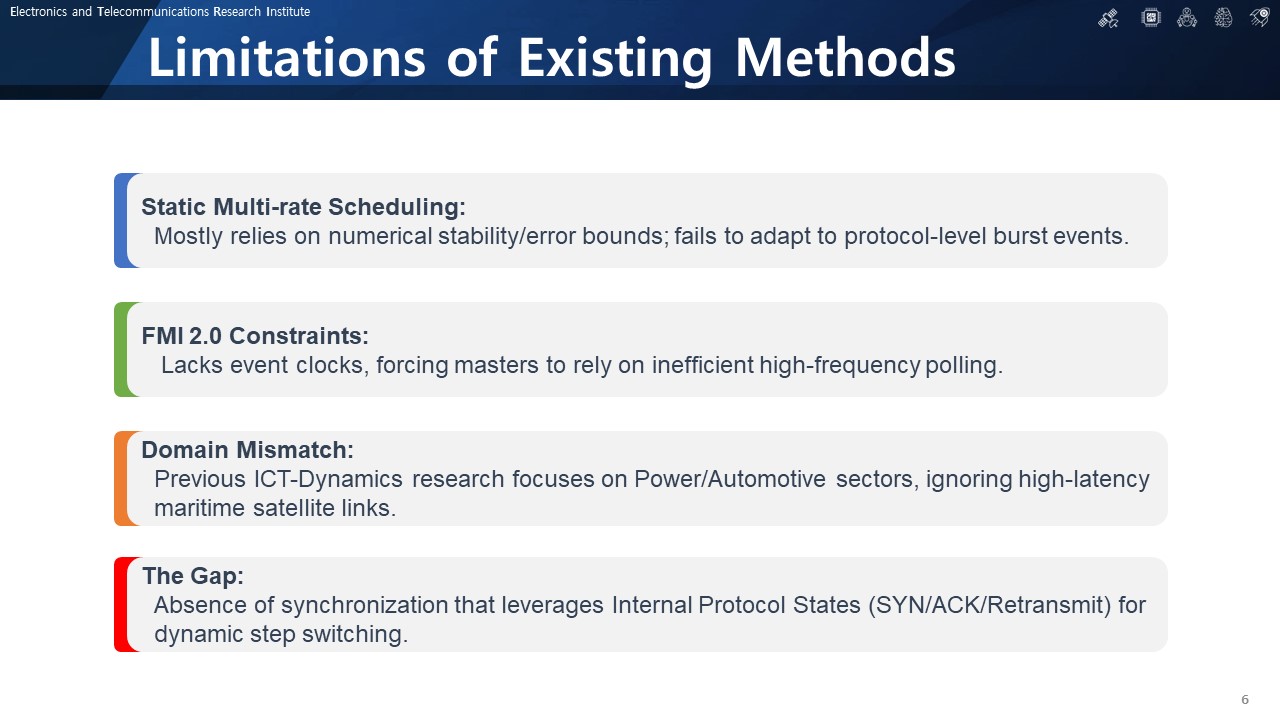
Existing approaches suffer from several limitations.
First, static multi-rate scheduling mostly relies on numerical stability or error bounds and cannot adapt to bursty protocol-level events.
Second, FMI 2.0 lacks explicit event clocks, forcing master algorithms to rely on inefficient high-frequency polling.
Third, although communication–dynamics co-simulation has been studied, it mainly focuses on power systems or automotive domains and does not reflect high-latency maritime satellite links.
As a result, there is a clear gap:�no FMI 2.0-compatible synchronization method that leverages internal protocol states, such as SYN, ACK, or retransmission, for dynamic step switching.
|
 IEEE/ICACT20260349 Slide.06
[Big Slide]